' ' '
Atlantis Artist Spotlight
Written by Joshua Allen
Founder and Executive Director, The Atlantis Awards
“I don’t need to be a king. I want to be a farmer in film, with a lot of other farmers.”
Quotations have been lightly edited for clarity and length.
Four People in a Bathtub
A play performed in an East Village bathtub for four people was not a lesser version of Daniel Talbott’s artistic life.
When he recalls making work at that scale with Samantha Soule, he does not describe a humble beginning redeemed by everything that happened afterward. The small production mattered as much as her Broadway work. They gave it the same commitment, and its value did not depend on whether somebody influential happened to attend.
“It was never like one was better than the other because it would get me further,” he says. That distinction remains fundamental to how he understands success. The work is not an audition for the work that will finally count.
Talbott’s career has moved through acting, playwriting, directing, producing, and television writing without arranging those disciplines into a hierarchy. His plays include Slipping, Yosemite, and What Happened When; his television writing includes The Mist, adapted from the Stephen King novella, and ABC’s The Conners. He co-wrote and co-directed Midday Black Midnight Blue with Soule, which premiered at the Seattle International Film Festival in 2022. Rising Phoenix Repertory, which he leads as artistic director, and Orphan Andy Films, the queer production company he founded more recently, provide the structures through which his work intersects with the work of other artists.
He speaks about theater, television, and film as one continuous undertaking. The circumstances change, but the central decision does not: he wants to keep making things, keep learning how to make them, and remain among people who understand why the effort matters. Recognition may accompany that life. It cannot be the only thing holding it together.
When someone recently called him a king of queer film, Talbott found the description frightening rather than flattering.
“I want to be a farmer in film with a lot of other farmers,” he says. He wants to work, grow things, improve, and serve the people working beside him. Almost immediately, he adds that he has strong opinions and a strong will, and that his commitment to the work can be intensely demanding.
Both statements belong in the portrait. Talbott is not proposing that collaboration requires an absence of conviction. He is describing an artistic life in which conviction becomes useful through contact with other people — and in which the person assembling the community also needs what that community can give him.
Work Without Permission
Talbott founded Rising Phoenix Repertory while he was still a student at Juilliard. The company developed through readings, workshops, new plays, and productions in both conventional theaters and spaces never designed to contain them — its history includes the Off-Broadway production of Slipping and the 2013 co-production of Martin Moran’s All the Rage with piece by piece productions, in association with The Barrow Group; All the Rage won that year’s Lucille Lortel Award for Outstanding Solo Show.
For Soule, who became an Artistic Associate during their years at school, the company changed the emotional terms of entering the profession. Auditions still mattered, but a rejection could no longer decide whether she would get to work that day. There might be a production meeting that afternoon and a performance that evening.
“You were never out of work if you had work that was yours,” she says. Rising Phoenix became a “home gymnasium for work,” a place where practice could continue without waiting for another institution to recognize its usefulness.
Talbott describes the same protection from the other side. Juilliard offered rigorous training alongside a recognizable model of professional achievement. The company allowed him and Soule to value a basement production even after an unsuccessful audition for a more established theater. They were already making something they loved; the rejection had not removed that fact.
Some of the productions he remembers most fondly were made with almost nothing. What mattered was the combination of people and what they could make from the available space. Orphan Andy now provides another home for that continuing practice, rather than replacing an earlier, supposedly less important phase of his career.
The company’s Cino Nights sharpened the principle into a demanding production method. Instead of asking playwrights to justify an idea before receiving permission to develop it, the artists invited them to write what interested them and committed to finding a way to stage it. Soule remembers fully realized, one-night-only productions assembled at a pace that was exciting, exhausting, and intensely educational. Each attempt supplied knowledge for the next.
The relationships became durable partly through everything that happened around the performance. Someone still had to clean the room at three in the morning. Eventually, those same people were sleeping on one another’s floors, sitting together in hospitals, and showing up through family upheaval. Soule says “collaborator” gradually became an inadequate description. They were living their lives together.
Andrew Klaus-Vineyard recognizes the same practical language in Talbott’s present-day life. Affection takes the form of meals, tickets purchased for a friend’s screening, calls made to find crew, and another pair of hands offered when a production needs help. Artistic family becomes credible because it produces actions beyond saying that everyone belongs.
Let the Camera Come to You
Chris Stack locates Talbott’s acting direction in a distinction between having more to give and having more to show. “He never fails to know if there’s more that you can give,” Stack says. “And that’s not to say more that you can show — it just means more that you can give, and more that you can have.”
In Midday Black Midnight Blue, Stack’s Ian can appear almost immobilized. Internally, the actor describes a man who is continuously searching: for the person he has lost, for a route through memory, for a way of living in the aftermath. Talbott helped him find emotional material, contain it, and identify the points where something might escape. Stillness did not remove the action. It changed where the action could be seen.
Talbott describes the same process through the camera. “There’s actors that go to the camera, and there’s actors that let the camera come to them,” he says. “I don’t think it’s ever about outward expression. If you’re really going through it, if thought is so active behind the eyes — when something’s clicking and burning, the camera comes into you.” He is looking for thought that is actively occurring, something the camera can observe rather than an outward demonstration designed to tell it what to record.
The practical route varies. Sometimes the actor is already available to the material. Sometimes fatigue makes an apparently simple moment unexpectedly difficult — Talbott recalls one demanding scene coming together readily, followed the next day by an apparently simpler scene that proved harder because the team was exhausted. Sometimes the intervention is almost purely physical. “Sometimes it’s just push-ups,” he says. “Getting your heart rate up so you’re in your body and not in your head.” The useful intervention depends on the person, the day, and the scene.
He does not describe a technique that guarantees the result. He describes an ongoing effort to recognize what might help it happen. Stack says the trust required for that work includes knowing that private disclosure is not the price of emotional depth. Talbott does not require him to identify the personal secrets he draws upon. The actor can use them without handing over his history, trusting that the vulnerability will be honored and given a dramatic purpose.
That makes Talbott’s admission about Midday particularly revealing. There is a scene, he says, that they never quite achieved. “Every time I watch that film, I can just see the shift, and I’m like, oh, we never got that,” he says. “But we tried really hard to get it, so the attempt felt very honest, and I’m very proud of the attempt. We just weren’t there yet, as art. Now, weirdly, I think I know how to shoot that scene — I just didn’t have that tool at the time.”
The admission does not cancel his pride in the film. He remains proud of the honesty of the attempt, including the limit it exposed. The work records what they could do at that moment; becoming a better filmmaker does not retroactively make the earlier effort worthless.
Stack has watched Talbott’s vision become more “crystalline” while his grip has become looser — “he has a very clear vision,” Stack says, “and I think he’s become more comfortable with that vision, and hence is able to have a looser grip on the people who are helping him realize it.” Soule has noticed “some new layers of gentleness” and more room to breathe inside the rigor. Talbott receives those observations as something to keep working toward rather than a completed transformation. “I’m so fallible, and I’ve made so many mistakes,” he says, “and I think all of that makes me who I am as an artist. The older I’ve gotten, the more I’ve been able to accept that — actually come to love it, more than when I was a kid, when I thought any mistake was the end of everything. Now I kind of love mistakes, as long as they don’t hurt anybody, or fuck with the project getting made.” He hopes, he says, to wake up better at it tomorrow.
The Film That Changed Its Makers
Midday Black Midnight Blue did not begin as the film Talbott and Soule ultimately made.
The original screenplay was set in Michigan and conceived around particular locations. When those locations fell through, the filmmakers turned toward the Pacific Northwest. The replacement landscape changed more than the production plan; it altered the story’s emotional possibilities.
Soule describes the Michigan version as darker and angrier. Moving west meant that Ian and Liv had reached another life before losing it. Their tragedy was no longer defined entirely by an inability to escape. They had escaped, and the future still broke apart. For her, the additional hope made the loss more painful.
Talbott’s account emphasizes the new landscape’s scale and volatility. “All it did is it went from the size of a lake in depth to the size of an ocean in depth,” he says — a shift the film’s cinematographer, Piero Basso, had to find a visual language for. Water, darkness, wildness, and the losses unfolding around them during the pandemic drew the project away from a more linear narrative and toward something less orderly. “I think the world kind of tells you the direction you’re supposed to go,” he says. “It doesn’t mean you don’t prepare, it doesn’t mean you don’t work hard. But if you give in and you pivot, you’ll get another side of the prism of what you’re trying to make.” He describes listening to the place as a form of collaboration.
The different emphases are part of the authorship. Soule sees the altered relationship between hope and devastation; Talbott sees an invitation to a wilder formal language. Neither account needs to replace the other for the resulting film to make sense.
The same instinct showed up, on a much smaller and more literal scale, on his most recent television production, when a location he’d already secured proved unsuitable. “In four hours, we completely changed towns and locations, and still got three shots that day, and stayed on track,” he says. “If anyone had panicked, we would have lost so much time. But everyone was just like, cool, let’s pivot. It made it ten times better.” It is the farmer’s version of a crisis: you don’t fight the weather, you read it.
Talbott is careful to distinguish that openness from failing to prepare. Listening to circumstances does not excuse wasting resources or somebody else’s time. Preparation makes it possible to recognize a new route and take it together when the original one disappears.
Talbott knew the result would not be for everyone. Its value to him lies partly in being allowed to make that particular film, with those people, rather than exchanging its singularity for a more readily legible version of success. The same principle that protected the bathtub production also protects the experiment.
Something He Could Not Make Alone
The freedom Talbott gives another filmmaker can extend beyond revising a shared project.
In 2020, as Soule began exploring her own directing language, he sent her a theater piece written for two men on a bench overlooking the ocean. He encouraged her to use whatever interested her, dismantle the text, and make something of her own. He did not want her returning to him for rewrites or permission at every stage.
The result was Birdwatching, directed and edited by Soule: Amanda Seyfried and Sharon Washington moving through a wooded landscape, their voices gradually beginning to echo and carry one another’s memories. Soule discovered much of the film’s organizing logic in the edit. Talbott’s language remained, but her arrangement of it produced a different relationship between bodies, memory, and place.
For Talbott, the transformation was something to want, not merely something to permit. “I’m always hoping they’ll discover something — that it’s a true conversation between different heads and different hearts and different body parts,” he says. “It’s such a deeper dig when there’s more people digging. I never feel like it has to be what’s in my head. If I’m close to feeling that way, I’ll direct it myself.”
He also recognizes that he cannot release every project equally. Sometimes he wants a film to remain close to an image he carries, and that may be a reason to direct it himself. Even then, the attachment can change. A screenplay he once felt compelled to direct may eventually become something he wants to place in someone else’s hands. That is not indecision in his account. It is another consequence of remaining open to what he does not yet know.
Until the Time We Die
That same principle now extends to one of Talbott’s most personal screenplays.
Talbott has been developing Until the Time We Die with Lena Headey, who he says has agreed to direct, and Jack Cameron Kay, who is attached to star.
On the page, Until the Time We Die expresses much of its emotional life through practical acts. Taylor arrives at his brother Cody’s trailer with groceries, makes coffee, prepares food, cuts his hair. The affection between them is substantial, as is the imbalance in a relationship around which Taylor has organized much of his life. After Cody’s death, versions of that care begin reaching Taylor from other people — a new relationship brings food, company, physical tenderness, and the possibility of being looked after rather than always being necessary. The screenplay does not replace his brother with an equivalent person. It enlarges the number of people through whom life can reach him.
Talbott is emphatic about the direction he wanted the story to take. “I wanted to be honest about where I came from, but I wanted him to win in the end,” he says. “That was important to me.” Permanent devastation would not make the original suffering more authentic. The possibility of a future is part of what the writing is fighting to preserve — a writer’s choice about what a story owes its characters, not a chronicle of what inspired it.
What a Choice Costs
Talbott’s interest in material circumstances is not limited to producing. Money frequently determines the available actions inside his stories without becoming the subject of an explanatory speech.
In the screenplay for Until the Time We Die, Taylor shops for groceries, watches prices, and carries supplies to his older brother. A modest gift to a family outside the store costs him something. Later, the possibility of college runs into the plain fact that loans eventually have to be repaid. Class is present in the distances people travel, the work they cannot easily abandon, and the futures they cannot simply choose — never in a speech about being poor, always in what a scene requires a character to do next.
“It’s about class,” Talbott says of the screenplay, “but also how different it is to grow up in a working-class environment if you’re queer.” The screenplay works that way: the film isn’t making a speech about class, it’s showing what class costs a specific person in a specific scene, and trusting the audience to do the arithmetic themselves.
Andrew Klaus-Vineyard likes to point out a lighter side of that same fluency: Talbott can talk knowledgeably about couture — the fabric, the tailoring, who made what. After Andrew told me this, I decided to test it myself, and put a lightning-round fuck-marry-kill to Talbott directly: Gucci, Prada, Dolce & Gabbana. He didn’t hesitate. “Kill Dolce & Gabbana,” he said. “Marry Prada, and fuck Gucci — I mean, Gucci would be the best fuck in the world.”
The same instinct governs how the screenplay renders love. Taylor’s care for Cody requires fuel, food, time, and physical presence. It is tenderness performed through work, and the work has consequences for the person doing it. Care is meaningful partly because it is not free of cost.
Talbott’s attachment to small productions should be understood in that same context. He does not need scarcity to make a project valuable, and he does not regard a larger production as inherently compromised. His insistence is that lack of money cannot be allowed to settle the question of whether the work deserves to exist.
Bring Your Own Version
Klaus-Vineyard calls Talbott “the great connector.” The phrase describes something more specific than sociability: he introduces artists whose abilities may complement one another, creates opportunities for work that is difficult to place, and helps turn admiration into an actual collaboration.
That process can begin quickly. Talbott first met the actor Brandon Engel outside an Indian restaurant near the Directors Guild of America during Slamdance, and the encounter stuck with him. Seeing Engel’s performance in Sam Tricomo’s Puke Bitch sharpened that impression into something specific, and as Talbott began thinking about the younger characters in Lay All Your Love Right on My Door, Engel kept coming back to mind. Further contact, including another encounter at SeriesFest, became a conversation about working together. “I really trust my instinct on stuff,” Talbott says. He says he came to consider Engel family remarkably quickly — “like my little brother.”
The chronology matters because it shows that belonging, in Talbott’s account, does not require a long apprenticeship within his circle. Shared history can deepen trust, but it is not the only way trust begins.
“If they show up, and the play is the thing, the film is the thing, and I can sense that, even if it’s not my version of it, I really trust that,” he says. Generosity matters too, but it does not have to resemble his own.
The qualifications are essential. He is asking for commitment to a shared undertaking, not agreement with every decision he makes. He wants knowledge and uncertainty, individual habits and fallibility — the particular human being who can contribute something he does not already possess.
“Why is my opinion better than your opinion?” he asks. “It’s not.” What takes precedence is the story they are trying to tell collectively.
His longstanding collaborators describe that distinction through actual changes to the work. When Klaus-Vineyard directed Slipping, he persuaded Talbott to reverse the final two scenes, changing the emotional experience with which the audience would leave. The disagreement did not require either artist to abandon the play. It required them to consider what a different arrangement might make possible.
Soule offers another correction to the familiar mythology of artistic partnership. She and Talbott are sometimes described as sharing a brain, but she thinks that misses the source of their connection. Their backgrounds, bodies, instincts, and tastes differ. They have become fluent in those differences without eliminating them. They remain, she says, “really curious about each other’s brains.” The collaboration survives because each perspective can still teach the other something.
What Success Costs When You Define It Yourself
A few years ago, Talbott made a conscious decision to focus only on queer work going forward. “He made a real conscious decision,” Klaus-Vineyard says.
Talbott’s own language about success places that choice inside a standard he had already set for himself decades earlier. “Being honest about the type of work you want to make, and what success is to you, not to the world, is such an important thing to be honest about,” he says, “and I feel like a lot of people are not honest about it in our culture. A lot of people are great at marketing themselves as this whatever thing, instead of actually being the artist that they really, truly are.” For Talbott and Soule, he says, “our true desire was always: I want to make theater, TV, and film, no matter what, even if I have to work seven other jobs to do it, even if I suck at it.”
That same standard is the test he runs on the people he works with now. “What I see a lot is people using indie film or indie television or smaller projects as a stepping stone to a career that they think they deserve,” he says. “I don’t think anyone deserves anything. No one has held a gun to my head to say I have to go be a filmmaker. I chose all of this, and for some people that means you’re going to win an Oscar. For a lot of people, it means you’re not — you could still be just making work. You may not be a household name. You may not drive a Porsche. That doesn’t mean you’re not a filmmaker.” If someone shows up because the film is the thing, he trusts them instantly, whatever else is true about them. If he senses the reverse — that a person’s own career is the actual project, and the film is only the vehicle — his patience disappears fast. “We’re there to make a film and tell a story. I’m not there to build your career, and you’re not there to build mine.”
What Trust Has to Hold
Talbott’s belief in collaboration does not make him an undemanding presence, but those demands are pretty straightforward; he wants ambition directed into the thing they are making together. There is a danger in performance, he says.
“I don’t mean bad danger, I mean good danger — there’s something you risk, something you give up, in the giving that is great acting, great work, to an audience,” he says. What earns almost none of his patience is a different kind of risk entirely: a collaborator whose real project is protecting themselves. “It’s amazing to me how many people talk about wanting to do risky work, and what they actually want is to be successful and taken care of, and for the world to be a padded room just for them. You’re not going to make great work that way.”
Klaus-Vineyard describes those standards as energizing rather than exhausting for the collaborators who return to Talbott again and again. He points to Samantha Soule and Chris Stack, each with him across multiple projects over several years, and to Lovell Holder, Piero Basso, and himself, among the artists who keep coming back to work with Talbott.
Soule’s account supplies the other half of the relationship: what happens when commitment includes saying no. She has spent years learning to recognize and articulate her own needs rather than automatically offering the response somebody else wants. When she tells Talbott that something is not okay for her, she says, he respects it. Their history allows him to understand that reaching a limit does not mean abandoning him, the work, or herself. The refusal belongs inside the collaboration. It is information about a person who is still present and trying to work honestly, not evidence that the relationship has failed.
Talbott’s broader understanding of commitment comes partly from theater. Even a dream role can become familiar over a long run. “Four or five years into running that play, if you’re still doing it, you are going to feel stale,” he says, “even if it’s your favorite play in the world. There’s something so beautiful about having to find ways to reinvigorate, reinspire, and recreate magic all the time. I’m sad that people give up on things so easily now.”
He recognizes a similar responsibility in relationships, where care requires more than the persistence of an early feeling. He also distinguishes continuing to love someone from continuing a daily relationship that damages both people — he described, without naming names, a close friendship he’d had to step back from years earlier, one he considers unresolved rather than ended. “I’m still in the ring with him, in a very profound way, and always will be in my heart,” he says. “Are we good for each other day to day? Probably not. But I love him the same, and I’ve never given up on him.” It is the same discipline at a different scale: whatever keeps a four-year run alive is not so different from what keeps a years-long collaboration alive, and he treats both as something that has to be actively renewed rather than assumed.
The home he describes must therefore hold disagreement, limits, and change, not merely loyalty expressed through agreement. It is the farmer’s other job, the one that gets left out when people only talk about growth: knowing what to cut back so the rest of the field can survive. His collaborators do not make his convictions disappear. They give those convictions somewhere to encounter another reality.
Love Is the Engine, Not the Wound
“The joy is what activates the struggle,” Stack says of Talbott’s work — a claim he extends into a larger one about what actually sits at the center of it. “At the core of all of these characters, and all of these stories, is love. Characters motivated by love, whether they’re protecting it, searching for it, or trying to recapture it. And when love is at the core, you can’t help but have moments of joy and great connection and deep humor.” When I put a version of that argument to Talbott directly — that a film like Midday isn’t really a story about grief so much as a story about love, and that without love there’s no grief to speak of — his answer came without a pause: “100%.” He went further. “I think everything comes from love. Every story I’ve ever told is a love story, even if it doesn’t seem that way. You can’t hurt someone who’s not in love. But if someone’s in love, you can really destroy them — because it means so much, and it’s so vulnerable, and it’s so tactile and physical, in their body.”
The characters’ suffering has force, in other words, because something remains worth losing. Humor and connection are not decorative interruptions of the darkness in his scripts. They are what make the darkness legible as loss in the first place — a writing principle as much as a personal one.
That principle shapes the documentaries he has co-directed with Klaus-Vineyard as directly as it shapes his fiction. In Welcome to Tool Shed, the camera watches the bar being prepared before the title arrives; sweeping the floor is part of the welcome. The film’s portrait of queer elders allows humor, sexual life, affection, and unfinished individuality to coexist with testimony about survival — a directorial choice not to let hardship flatten anyone into a monument. Stand Tall, Go Higher turns toward filmmakers, letting jokes, interruptions, and differing opinions complicate a shared commitment to making queer work; its practical questions return to what people can make with the resources and collaborators actually available. Neither film requires its subjects to define visibility or artistic responsibility identically before they can share a frame.
In both works, community becomes observable through the behavior of particular people rather than through anyone’s stated position. It’s the choice that gives both documentaries their texture: rooms full of people who can surprise, challenge, and amuse one another on camera, rather than a cast of interchangeable spokespeople for a cause.
Klaus-Vineyard likes to point out how far that appetite for joy extends into Talbott’s own life: a filmmaker who can talk for an hour about class and queerness will just as readily admit to watching Heartstopper on a loop, or to being a devoted Disney adult. “He really is — he has a Mickey tattoo,” Andrew says.
A Wider Frame
The collaborative structure Talbott builds becomes most consequential when his own vantage point is insufficient.
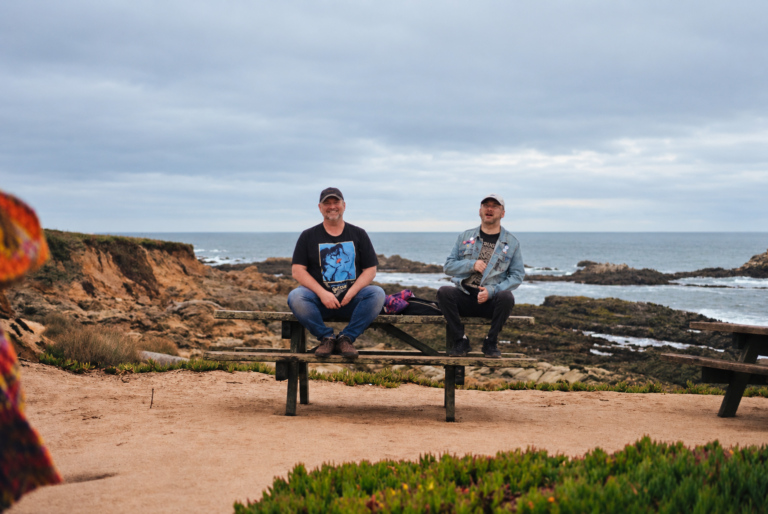
While shooting the first episode of Lay All Your Love Right on My Door, Talbott found himself directing in a location where his own history made it difficult to maintain the larger perspective the work required. What got the work made was the collaborators around him: Samantha Soule, Chris Stack, Brandon Engel, and Seth Collier, people from different stages of his career, some of whom he has known since Rising Phoenix. “I needed people who’ve known me for so long, who I consider family,” he says. Their job wasn’t only to reassure him. He needed people who could tell him when his own history was narrowing how he saw a scene — who could call him on it, in his words, when he was seeing something through a self-centered lens rather than a large one — and hand the work back a wider frame when his own vantage point threatened to become the only one in the room.
That’s a production practice as much as a personal one: on emotionally demanding material especially, Talbott values collaborators who will challenge a reading that’s become too narrow and offer another way into the scene. It’s the same logic that runs through his casting philosophy above — trusted collaborators aren’t there to defer to him. They’re there to keep the work honest when he can’t see it clearly himself.
Asked what he means by home, Talbott names people and the work itself: “I wanted to build a home that held everything I am, and could be, and I’m trying to be, and have failed to be.” Cinema belongs inside that structure for him. “For me, film and a cinema is spiritual,” he says. “It makes me ask questions about everything I don’t understand.” For Talbott, that’s what the work is for: a way of asking questions ordinary life doesn’t resolve, without the authority of anyone claiming to possess the final answer.
The bathtub and Broadway belong to the same life because the essential activity is the same: people putting what they know, what they lack, and what they can risk into something none of them could make in quite that way alone. The scale does not determine whether the encounter matters.
Talbott helps build the home, but he cannot build it by himself. Its usefulness depends on other people having something to offer — and on his willingness to receive it.
He is inside it with them, working.
Editorial Afterword: What to Watch For
Near the end of our conversation, Talbott ran down what’s next for him. He named only a handful of titles on the immediate horizon, while his publicly listed slate suggests there is considerably more in motion — film and television both, longtime collaborators and new ones alike.
- Lay All Your Love Right on My Door — the television project discussed above, with its first season expected to finish shooting in December.
- Until the Time We Die — Talbott’s own screenplay, discussed above.
- Gray — a film Talbott describes as one he loves, co-produced by Denmark’s Motor and Killer Films, with Martin de Thurah attached to direct.