
' ' '
Coordinating Belief
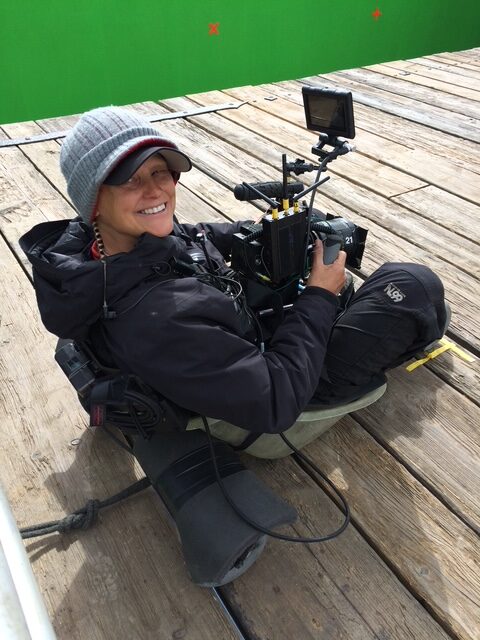
“What goes through the lens is there for eternity.” — Eunice Huthart
There is a distinct moment in modern action cinema where the illusion of physical danger routinely collapses. It rarely occurs because a stunt performer falls incorrectly or a wire setup fails; rather, it happens because the camera choice betrays the reality of the scene. When an action sequence is constructed from disparate pieces of multi-camera coverage — disconnected angles captured from a distance and stitched together in an editing suite — the audience is quietly extracted from the narrative experience. They stop tracking a character in jeopardy and start watching an exercise in post-production assembly.
Eunice Huthart’s body of work exists as an uncompromising refusal of that collapse. Across a career spanning more than three decades, Huthart has built an action philosophy that measures success not by raw kinetic spectacle, but by something far more elusive: absolute belief.
Nowhere is that philosophy more fully realized than in her recent work as both stunt coordinator and — for the first time in her career, officially — second unit director on Kraven the Hunter. The physical grammar she and her team engineered for the film stands as a genuine achievement in action design. The character does not move with the standard vocabulary of a cinematic stuntman; he moves with the raw, calculated physics of an apex predator. It is a transformation of physical presence on screen that redefines how weight, momentum, and instinct can be communicated through a lens — built by a coordinator who does not design stunts to turn heads, but to make sure the audience never wakes up from the movie.
The Architecture of Protection
To understand Huthart’s method, one must examine how she protects the people executing it. Action design carries a certain romance around its own history of bravado — performers throwing their bodies at concrete with minimal insulation, because that was simply the job. Huthart’s career traces the industry’s evolution away from that gamble and toward something closer to engineering.
“It’s improved for the better,” she says, reflecting on her thirty-three years in the business. “We’ve got a lot more technical. When I came into the industry — and pre-twenty years before that — we weren’t so scientific with our, sort of, manufacture of the stunt.”
The specifics are concrete: “Nowadays we have the source of finances to put a false floor in, where you’ve got crash mats under a false floor… you could fall from twenty feet onto something that will look like the floor, and it will protect you. But when I started in the industry, that would have just been a twenty-foot fall to the floor.”
For Huthart, this shift is deeply personal. Two hip replacements and a knee replacement still to come are the physical ledger of her early career, and they are precisely why she treats modern safety architecture as an obligation to the generation she now supervises.
“I’ll always argue with the director,” she says. “If you’re going to do a cut, I want the stunt performer to land on crash mats, because you don’t need them to land on the floor if we’re going to cut to the actor. So I will purposely protect it more.”
The ultimate goal is longevity and respect for the performers’ futures. “Our stunt performers now are not going to be getting hip replacements in their late fifties. They’re gonna be able to run around with the grandkids a lot better than what I can.”
Lens-Perfection and the Eternity of the Frame
The second pillar of Huthart’s philosophy is an unyielding relationship with the permanence of the frame. What feels spectacular to the naked eye on set and what actually reads through a specific lens are not always identical, and Huthart resolves that tension entirely in favor of the camera. A stunt does not fully exist for her until its geometry with the lens is exact.
“I see perfection in everything I do,” she says. “It’s my downfall, because I’m never really happy—I’m always like, this isn’t perfect.” That same instinct, she notes, made her mop the floor of a McDonald’s during a ten-year stint there until “it would be the cleanest floor you’ve ever seen,” years before she ever coordinated a stunt.
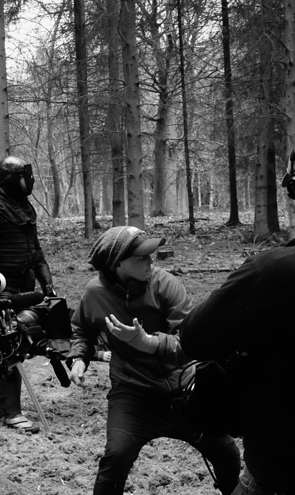
It also shapes how she selects her crew. “I will only employ the people I know can deliver the job,” she admits. “I’m not very good at allowing new performers to cut their teeth with me. I wish I was better. But I don’t want to take the risk.” She is candid about the motive: “I’d say I’m protecting myself, selfishly, because what goes through the lens is there for eternity. If it’s not perfect, I can’t sleep at night.”
That standard restructures how preparation is executed under her leadership. Nothing reaches the set unverified. “I cover bases very well,” she says. “I’ll say to SFX, I want to see five rehearsals where it’s repeated the same. I’ll give the props to stunts and say, I want them to rehearse with it—I want to see if it breaks after two run-throughs of the choreo. And sometimes it does, so we go back and they make the prop better. I flush out what doesn’t work early on, so that when we’re shooting, it’s not a problem.”
The discipline pays off in concrete terms: across roughly fifty second-unit days during principal photography on Kraven the Hunter, her team accumulated only about two hours of overtime across the entire schedule. “I say to them, you’ll never go over, you’ll never reshoot any of it,” she says. “What goes through the lens will always be what we use.”
Whether or not a film ultimately evolves in post-production is a separate question. Huthart’s concern has always been the same: that every frame leaving her unit is captured with the confidence that it can stand on its own. The responsibility of the stunt department ends when the camera cuts. The responsibility to that image does not.
Geographic Continuity and the Mechanics of Immersion
The permanence of the frame only matters if the space inside it holds together. This is where Huthart’s perspective on action filmmaking sharpens into a core commitment to the audience’s visceral experience. When a sequence relies on fractured coverage — angles that do not match, cut together to disguise a gap — the audience loses its bearings, and the narrative illusion goes with it.
“If I get taken out of it, I don’t believe it,” she says. “I always want people to be immersed in it — like I want to be immersed in it. So if I’m watching a James Bond scene, and a couple of my good friends have done James Bond, I’m not slagging that off — but sometimes I’m like, I know you’ve used a bad cut there because you haven’t got the right footage. Now I don’t know where I am geographically, because you’ve punched in and the angle’s wrong and it doesn’t blend with the continuity of what you’re shooting.”
That same demand for coherence extends to performance, not just camera placement. Huthart holds actors to the same standard she holds a wire rig. “I’ve constantly said to actors, ‘I don’t believe it. I’m looking at you and I’m seeing someone just trying to do a stunt. I’m not seeing the character in danger. You’ve got to give me more.’ I constantly sort of semi-direct and act as well, on that level.”
Her benchmark for what immersion should feel like has nothing to do with visual scale:
“One of the best films I’ve ever seen was All Quiet on the Western Front. The way that film was shot, I felt the cold. I felt the hunger. I felt the fear. That’s what I want in anything I deliver — whether it’s danger, whether it’s pain, whether it’s euphoria, whether it’s the suspense of trying to escape. That’s the only way I know how to do it, really.”
The Apex Predator Physics of Kraven the Hunter
This pursuit of physical truth, environmental weight, and spatial clarity converges completely in Huthart’s design for Kraven the Hunter. The central challenge was architectural: how do you build a human body that carries the weight, momentum, and awareness of a large predator, without falling back on generic digital tropes?
She began not with standard comic-book choreography, but with a close study of Aaron Taylor-Johnson’s own physical instincts. “Aaron is a very physical guy,” she says. “I did a lot of research when I knew he was going to be cast as Kraven, and I found this dance video he did. I must have watched it a hundred times. What I kept learning is he really understood where his physical balance was, and where his weight was. He understood his body very, very well. I wanted that to become part of Kraven as a character.”
From there came a three-month pre-rehearsal training regimen built deliberately around fluid discipline and explosive adaptability — utilizing ballet and parkour — followed by a live test on set. “I set him an assault course and got all the guys watching,” she says. “I wanted us to watch where his balance is, where he lands, how light he lands with his feet, because we wanted him very animalistic.”
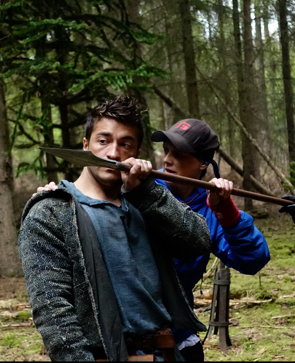
The ambition ran directly into human anatomy. “I wanted the character to be able to go to all fours naturally,” she says. “But what we discovered — I got an animal-movement guy in — is our limbs don’t work for it. The forearms, the leg limbs, our arms are shorter than our legs. They don’t complement a true animal.” A genuine sprint-to-quadruped transition at full speed, “like a cheetah,” simply is not naturally available to a human skeleton.
Rather than abandon the idea, she built a hybrid physical language. “We developed a sort of rudimentary, bastardized version of that transition,” she says — human momentum and selective wire assistance combined to suggest the shift from an upright sprint into something lower, faster, and unmistakably predatory, modeled on the distinct traits of a cheetah and a lion.
When animal reference alone could not solve a sequence, she looked elsewhere for the same quality of grounded, forward-driving force. For a scene where the character clears a corridor of armed guards, she turned to an entirely different sport. “We actually based one scene on an American footballer,” she says. “I couldn’t find anything in the animal nature that served what we wanted, and the best version I found was when a footballer runs with the ball and people are pounding around them. I was imagining that it was him, protecting himself. We based part of that scene on it.”
In the film’s quietest predatory beat — Kraven slipping through a citadel corridor, moving seamlessly in the blind spots of a guard patrol — the idea was entirely her own. “That was actually my idea,” she says. “We went for a recce at that place and I was like, he should just be invisible. He’s an animal — he should understand where the wind blows, where his scent goes. He’ll know if there’s a window open. He’ll know when people are coming, off the scent of it. We were like, no, you should just be next to these people but invisible, as an animal.”
The Chase
Ask Huthart which sequence in the finished film she is proudest of, and there is no hesitation. “I love the car chase,” she says. “I loved it. I don’t know of a car chase where someone is running around the outside of a car trying to break his way in. I didn’t want it to end. I wanted it to carry on.”
Insurance meant Taylor-Johnson couldn’t be on the moving vehicle for those specific high-risk beats — an ordinary constraint on a modern production, and the protection principle in practice yet again. What filled the gap was a collaborative act of invention from stunt performer Joe Kennard, who effectively helped co-author the sequence’s physical language as they built it.
“If we hook me in here, or give me a little bit off there, I can get right round the other side of the car,” she recalls him proposing. “He helped us develop that a lot further than anyone else. I always think of Joe Kennard on that scene, and what he gave to it.”
The feet were their own puzzle — true barefoot running through London streets where the surface allowed it, finished with flesh-toned protective soles, prosthetics, and a visual-effects pass where needed. It’s unglamorous, exacting work, chosen shot by shot — the same instinct, in miniature, that solved the animal-movement problem in preparation. When the body alone cannot deliver the effect, it must be constructed out of a hundred smaller, precise decisions.
That same instinct built the film’s stunt-double architecture around Taylor-Johnson’s own training rather than a single generic double. “Joe Kennard was the all-round guy, Adam [Bowman] was the strength guy, Ollie [Oliver Parsons] was the gymnast,” she says — three distinct physical vocabularies, each gag assembled from whichever skill actually fit the frame. It is infrastructure an audience will never consciously register. It is, functionally, the same logic as the false floor and the crash mat: build the invisible support first, precisely enough that nobody watching ever has reason to notice it was there.
Authorship, Earned Quietly
Kraven the Hunter marks Huthart’s first official credit as a second unit director, though the milestone mostly formalizes creative authorship she has quietly exercised for years.
“I’ve done a lot with directors before and never got the credit — I don’t mind, because if I’m given that role, I’ll know the camera will be where I want it in the right place. Kraven was the first official version where I was actually at my own unit, creatively.”
What she remembers of making it is, plainly, the teamwork and hard work of her unit. “It was great, actually,” she says. “I had a great team. We worked really hard.”
Of the unit’s discipline under a demanding schedule: “We were so prepped all the time. We knew what we were doing, where the camera would be.” Of her second unit DP: “Sam Renton was absolutely fantastic. He knew where the camera should be every time, what lens to always use.”
This is the throughline of Huthart’s career: directing second unit action is not an isolated exercise in securing coverage to hand off to a primary director; it is the execution of narrative storytelling through physical space. Her approach treats the action professional as a core filmmaker, fusing movement and lens choice into a single, indivisible unit.
Creative Control in an Age of Financial Control
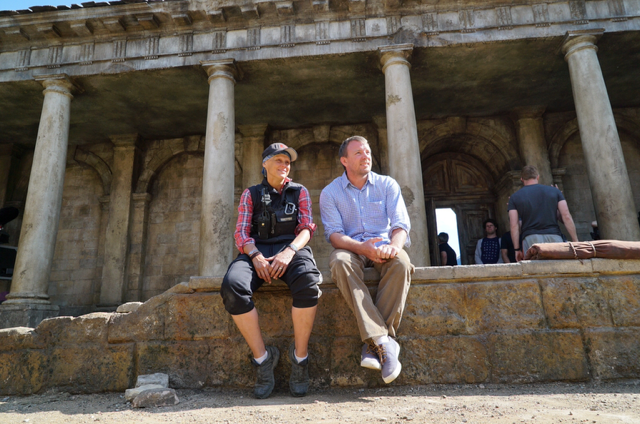
Huthart is unsentimental about what has changed around her over thirty-three years, and unusually direct about naming the force behind it. It isn’t safety standards or technology. It’s money.
“The industries are run a lot more by the financial controllers now,” she says, “whereas when I started in the industry, it was run more with the creative people. We were always pushing for the more creative side of things. Now it’s like, no, we can’t afford that, we need to do it like that. It’s run more on finances.”
She doesn’t romanticize the old system uncritically — she’s clear that the modern era has made the job safer and performers’ bodies more protected, a trade-off she values highly. But she is equally clear about what gets lost when a production is built around what accounting will permit rather than what a scene actually needs. It’s the same tension underneath the industry’s drift toward the kind of fractured, multi-angle coverage she describes losing herself in as a viewer: fewer resources for a director of photography and a stunt team to build a single, deliberate setup together, more pressure to shoot broad and sort it out later, in a room she isn’t in.
Set against that backdrop, the discipline described so far sounds less like a personal quirk and more like a deliberate act of resistance. Every hour spent in rehearsal, every prop tested to failure before the cameras roll, every argument won with a director over where a performer lands — all of it is Huthart insisting, project by project, on the older, more expensive, more creatively-led way of building a scene, inside an industry that increasingly has less patience for it.
The Part Nobody Thanks
Ask Huthart who in the industry deserves more recognition than they receive, and she doesn’t name an actor or a director. She names the riggers.
“When you do a fire job, everyone’s like, ‘Oh my God, that guy going on fire was amazing,'” she says. “It’s the guy putting him out who has more pressure than the guy on fire.”
She names her own crew without hesitation — including Jan Holicek, Arie Dekker, Dan Dow, Kierron Quest, Dan Rawlins, Liam Coote, TJ Roberts, to name just a few — and makes a point of recognizing them publicly when a sequence comes together.
“I’ll always name them, and we’ll give them a clap at the end of a great scene.”
The performer on fire becomes the image. The person managing the fire becomes the invisible professional who makes that image possible. For someone who has spent three decades building cinematic illusion, it is telling where Huthart’s attention naturally settles: not on the person receiving the applause, but on the people whose work allows the applause to exist in the first place.
What Belief Requires
Protection, preparation, and perfection are not three separate concerns competing for Huthart’s attention. They are different expressions of the same instinct, running underneath everything described above — the crash mats nobody sees, the geography nobody consciously tracks, the months spent teaching an actor to move like something other than a stuntman.
Ask her to explain why any of it matters this much, and she doesn’t reach for a grand statement about art or legacy. She comes back, as she always does, to the frame itself.
“What goes through the lens is there for eternity,” she says. “So for me, if it’s not perfect, I can’t sleep at night.”
That is the whole philosophy, in her own words. Not spectacle. Not scale. A stunt coordinator who has spent thirty-three years treating every shot as something permanent — and who has built her entire career, quietly, around making sure what’s permanent is also true.
Editor’s Note: Eunice’s work on Kraven the Hunter has been sponsored for consideration in the Best Stunt Coordinator category at The Atlantis Awards.