
' ' '
Atlantis Artist Spotlight
The Movies Are Smarter Than You Are
Written by Joshua Allen
Founder and Executive Director, The Atlantis Awards
“Form will never be the most exciting thing. It will always be psychology.” — Mathias Broe
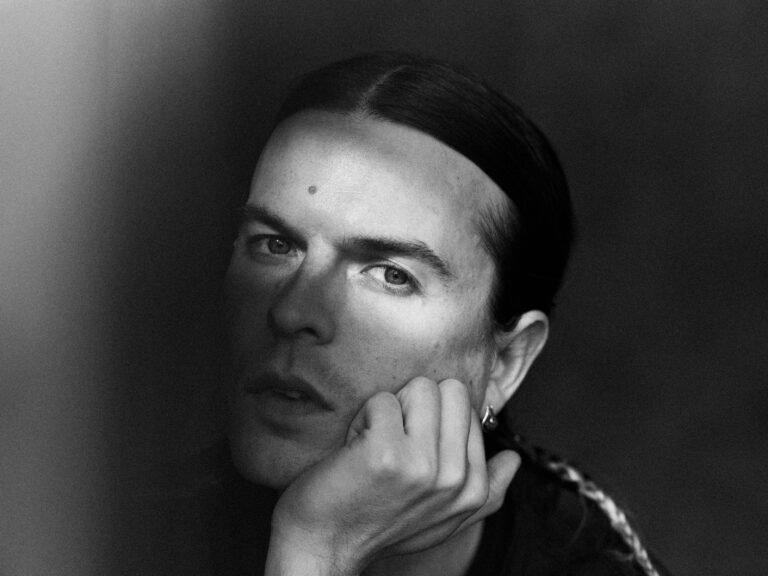
Spoiler notice: This conversation discusses character developments and the ending of Sauna.
Quotations have been lightly edited for clarity and length.
Mathias Broe is proud, first and plainly, that Sauna is still generating conversation. Making a debut feature was frightening enough on its own; making something this personal, and having it also open doors both in Denmark and internationally, was not an outcome he took for granted. What pleases him now is that the film keeps finding people, even when those people don’t agree about it. He hopes it builds a bridge between queer and mainstream audiences. He’s equally clear that it’s one story out of many that queer filmmakers should get the chance to tell — and that Denmark, in his own account, is behind on giving them that chance.
Our conversation begins there, with a finished film making its way through the world. It moves gradually toward something less easily summarized: the relationship between an artist’s preparation and the things that preparation can’t fully explain.
Broe talks about research, actors, editing, and production limits with real specificity. He can tell you exactly why a scene needed to be shorter, why the film needed more of Copenhagen than the budget wanted to give it, why a particular question in the source novel didn’t belong in his adaptation. He’s less certain, and says so, about where the underlying impulse to make the film came from in the first place — an emotional architecture he can point to but not entirely narrate.
Late in our conversation, he offers a way of holding that uncertainty without resolving it: “The movies are always more intelligent than you are in the moment,” he says. “If you are honest with yourself, and you dare to go where it hurts, then it becomes extremely interesting what comes out of things.” The work can know things its maker hasn’t consciously named yet — provided the maker is honest enough to follow a feeling before he can explain it.
That doesn’t make technique beside the point. It makes the relationship between technique and curiosity the interesting part.
Research Until You Can Be Unafraid
Asked when Sauna stopped feeling like an adaptation problem and started feeling like his film, Broe doesn’t reach for a scene. He reaches for a description of fear, and what it took to get past it.
He and co-writer William Lippert began the project with a pronounced political ambition — wanting, in his words, to “push some stuff” and to have the queer community embrace the result. Development brought in trans participants, additional writers, the novel’s author, and researchers studying queer representation at universities in Sweden. That accumulation of perspectives eventually gave the filmmakers enough grounding to make their own choices with confidence.
What changed wasn’t their willingness to listen. It was their expectation that listening would eventually produce a film everybody approved of.
“At some point, I think we had gotten so much input that we were like, okay, now we need to just make the movie we want to make,” he says, “and we need to just be unapologetically unafraid. Some people will love the movie, and some people won’t, and it’s fine.” He’s careful about the order in which that freedom arrived. He doesn’t think a filmmaker earns it simply by declaring himself fearless. Research takes real time, and personal proximity to a subject doesn’t guarantee understanding — even someone who has lived inside a community his entire life will still find things he doesn’t know.
Consultation gave Broe and Lippert the understanding necessary to decide which questions their film actually needed to pursue.
One of those decisions concerned a spiritual, nature-oriented strand in Lodahl’s novel — a strand Broe calls “very beautiful,” but whose questions about naturalness weren’t where he wanted the film to concentrate. “So we cut that out,” he says, “and then we could make a movie that was ninety minutes long.” Removing the layer didn’t just shorten the film. It helped the adaptation become something he and Lippert could recognize as their own. “That made us start to make a film that felt like ours, and not the book.”
He doesn’t dismiss how frustrating development can be — he shares the frustration — but he thinks the time is worth it if the filmmakers hold onto the spark that made them want to begin. The challenge, as he frames it, is to come out of research with a more precise film, not a more crowded one.
The Inner Landscape
Ask Broe what Sauna is actually about, underneath the plot, and he doesn’t describe a scene. He describes an architecture.
“I’m a very firm believer that every filmmaker — especially directors — has an emotional core that we have a hard time putting into language,” he says. There’s the person operating in the world, making decisions, talking to collaborators, and then there’s an interior place the tone of the work actually comes from. His own, he says, is melancholic. “I think that’s somehow what is being perceived in the film.”
He’s quick to add that this isn’t a claim that the movie simply happens to him — there’s directing technique, visual technique, the whole apparatus that turns a feeling into a finished scene. But underneath those systems, he recognizes what he’s steering toward: abandonment, the longing to merge with someone who isn’t ready yet, or the reverse — getting what you wanted and immediately wanting out again.
His account of Johan starts from exactly there. Johan is trying to find his footing in a community when he falls for someone who seems to offer the depth he’s been missing. William, though, is going through a transformation of his own, and isn’t ready to merge his life with anyone else’s. Johan isn’t ready either, even though he’s convinced merging is precisely what he needs. Broe thinks Johan needs a community and a place to belong first — without that foundation, one relationship ends up carrying weight it was never built to hold. “I don’t think you can belong to a person if you don’t have your community first,” he says, “because then you become extremely dependent on a human, and you should never be, because humans are like blip, blip, blip, all over the place.” It’s the mechanism, in his telling, by which two people can spend a relationship both healing each other and hurting each other at once.
Before we spoke, I’d gone back through a number of Broe’s earlier projects — student work and festival shorts stretching back roughly fourteen years, including an early piece he made as a teenager, Til far (To Dad). I suggested there seemed to be a throughline: a filmmaker who has always used a camera to give visible shape to things that are harder to say out loud, all the way back to that first project. It was a reading I offered him, not a biography I imposed on him.
Broe stopped and wrote the observation down. He runs similar “mirroring” exercises with his own film students, he said, but finds it much harder to do the exercise on himself — hearing the connection traced from outside, he said, felt “precise.” The observation becomes more useful later, when he describes a very different project in strikingly similar terms.
The People Who Change the Film
Research helped Broe and Lippert decide what they wanted to make. The people they cast, and the community around the production, helped them discover how much they could stop explaining.
On the page, Broe says, the script carried a fair amount of explanatory dialogue — lines clarifying the difference between gender and sexuality, what it means to be both gay and trans, what a gender identity clinic actually is. Once Magnus Juhl Andersen and Nina Rask were occupying Johan and William in physical space together, much of that scaffolding turned out to be unnecessary. “When you go from paper to physical space, it’s always very relieving,” he says, “because suddenly you can start to get a lot of things out.” Watching two actors make the psychology legible did work that description had been laboring to do on the page. “If people jump onto psychology, and you just lead them a bit of the way, they get engaged — and that’s the most important thing.”
Nina Rask — a well-known Danish comedian and actor before she was ever William — became more than a performer working from a finished script. Broe describes his conversations with her as an important part of shaping the character: he and Lippert were candid about the limits of their own lived experience as cis gay men, while Rask brought both her perspective and her instincts as a performer directly into the construction of William.
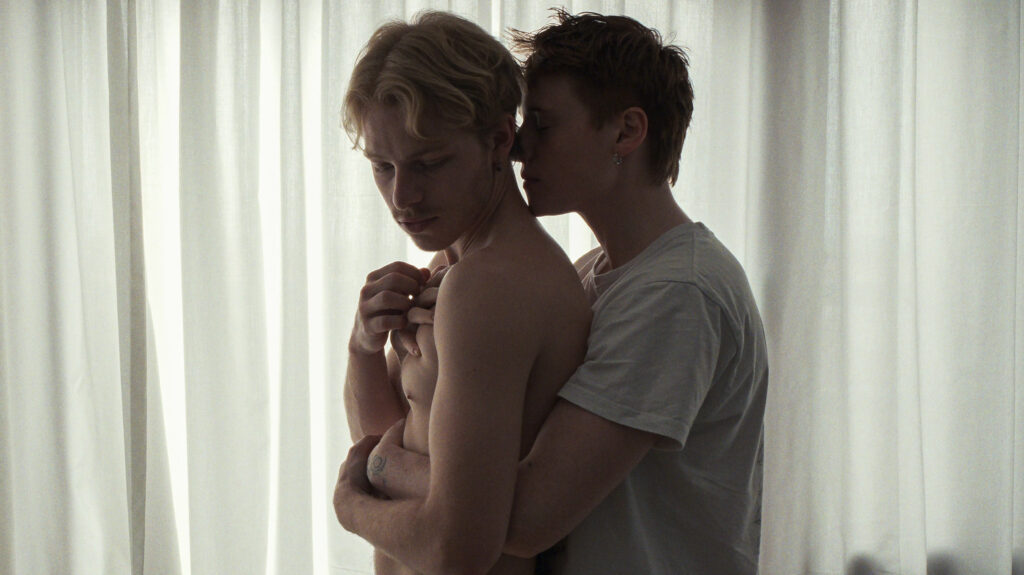
Broe’s own understanding of the material was changing during development too. His partner transitioned while the film was taking shape — an experience he has discussed publicly as both challenging and enormously clarifying, and one he says pulled him toward a clearer understanding of Johan’s own failures: “I felt like I became more and more Johan as we got along, and I also understood why he was fucking up.” He’s careful not to turn this into a claim that Sauna is a transcription of his relationship. It gave him firsthand access to some of the complicated emotions Johan experiences, without turning the fictional relationship into a record of his own.
Asked whether the vocabulary developed with intimacy coordinator Anne Sofie Steen Sverdrup — whom Broe calls, without hedging, the best in Denmark, someone with experience on both sides of the camera — carried over into the film’s quieter, non-sexual physical moments, he draws a clean line. Her work was scoped to the explicit sex scenes specifically. Everything else — touch without speech, withdrawal, the atmosphere of two people simply sharing a room — he claims as his own directing practice, and arguably his best. “I think that’s what I’m most good at,” he says.
Bergman, Meet Linda
If there’s one piece of pure craft philosophy in this conversation, it emerges through Broe’s collaboration with editor Linda Man, whom he describes with obvious admiration as “extremely sharp” and “a very hard editor” — meaning willing to challenge material whenever psychology demanded it.
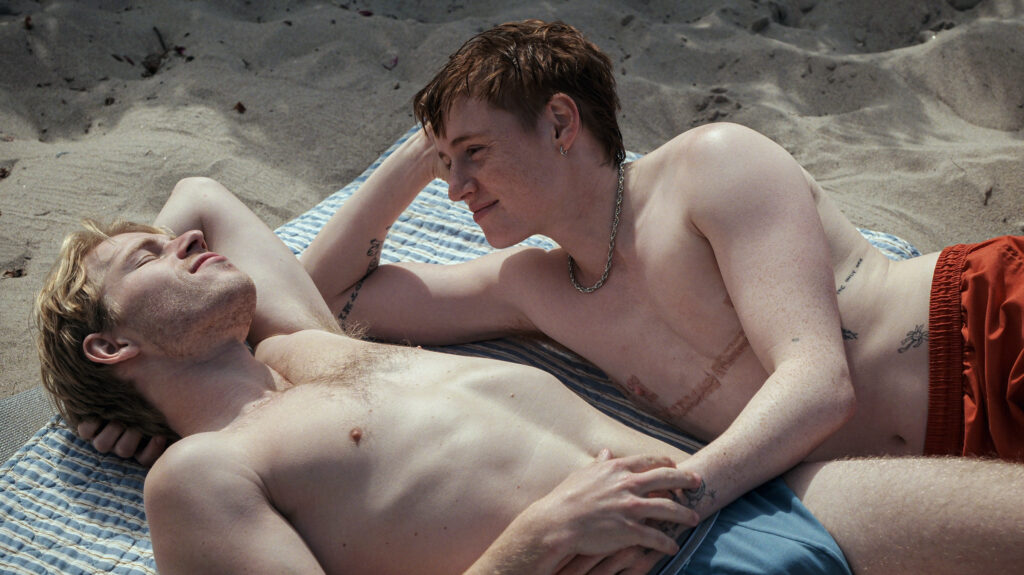
The clearest example is the beach scene, where Johan tells William about his first experience falling in love with a man. Broe’s original ambition was large: a long monologue sequence modeled on the eight-to-nine-minute confession at the center of Ingmar Bergman’s Persona, sustained long enough that an audience stops simply watching two people talk and starts constructing images of its own. Later in the film, those images would get a literal payoff — William standing on a shoreline, in white briefs, refusing to go into the water as he’d promised.
Man cut the monologue to about three minutes.
Broe doesn’t tell this as a story about an editor ruining an ambitious idea. He thinks the effect he wanted survives; what changed was his attachment to the specific duration he’d assumed the effect required. “She’s only editing on psychology,” he says. “She cares about plot, of course, but it’s not what she sort of goes with.” Asked whether his original version would still have cut between the characters rather than held in one unbroken shot, he says yes. His ambition concerned duration, not the absence of cuts: he wanted a substantial stretch in which time could seem to stand still and the audience could become absorbed in hearing the story. What he took from the experience wasn’t the runtime he lost. It was the principle underneath it: “Form will never be the most exciting thing,” he says. “It will always be psychology.”
That same principle shapes one of the sequences Broe says he is most proud of — Johan’s late return to the sauna, back into the orgy he’d once walked away from. He calls it “a what-is-time-and-space kind of way of editing,” built to match where Johan actually is emotionally rather than where a clock would put him.
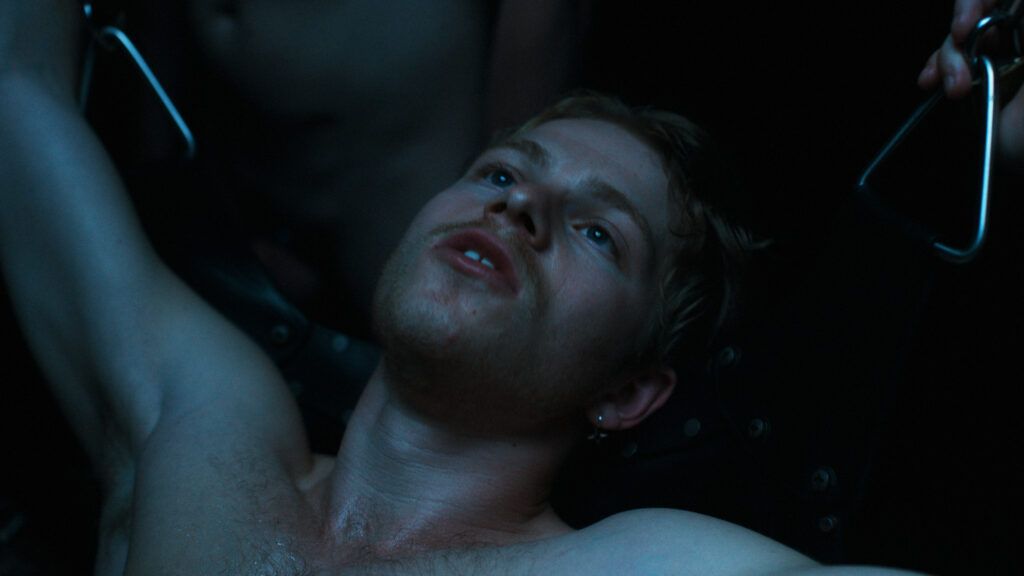
It’s the same instinct, at a much smaller scale, that governs how long the film lingers on a man sitting at the edge of a bed. During an early first viewing, I logged a moment that felt, at the time, slightly too quick: right after his first hookup leaves, Johan sits on the bed looking forlorn, and the film cuts away to the street almost immediately, before the feeling has had room to land. Much later, after he’s moved in with William, there’s an almost identical setup — Johan on the edge of a bed — and this time the camera holds for a good fifteen to twenty seconds. It breathes. I asked Broe about the gap between those two choices.
His answer is more exact than simply “the film follows psychology.” The early moment has to register that something hurt, he says, without suggesting the encounter has devastated Johan — this is a man getting used to a hookup culture’s use-and-move-on rhythm, and it’s possibly the first time he’s actually being turned away by someone he wanted more from. “It shouldn’t have too much,” Broe says. “He wasn’t too hurt, you know — then we would sort of start to question him too much.” The moment is a seed, not a payoff. “It just has to have the exact timing that you can then build on later, because we’ve already seen the emotion, and then we can build on it later on. But if you overdo the emotion too fast, then…” He doesn’t finish the sentence. He doesn’t need to.
That’s the real lesson tucked inside both editing stories. The long monologue and the short, early cutaway weren’t solved by the same instinct for speed or patience. Each required a separate judgment about what the character had actually reached, what the audience needed at that exact point, and what the film still wanted to keep in reserve to build on later.
The City Would Not Stay Outside
Sauna was made through New Danish Screen, the Danish Film Institute’s low-budget talent-development scheme for filmmakers moving into long-form work. The framework requires projects to be conceived so they can actually be realized within low-budget conditions, which tends to encourage contained production solutions. Broe had twenty-five principal shooting days, plus two more, and no illusions about the budget.
He sees real value in that kind of constraint for an emerging filmmaker — a workable shape is better than no shape at all — but he’s clear about the risk underneath it: a production solution can start dictating dramatic choices the story doesn’t actually support. Sauna nearly followed the more contained path. “I think in the beginning we thought we were going to be more in the sauna,” he says. As the film developed, that stopped being possible. “It needed to be Copenhagen, and not just the gay sauna.”
The expansion wasn’t simply a matter of adding attractive locations. The film’s own sense of itself outgrew the production assumption that was supposed to contain it. The constraint stayed useful. It just stopped getting to decide the size of the world.
One Film, More Than One Audience
Once that world reached audiences, it didn’t get one answer back.
Broe describes reactions that split sharply, including within the queer audiences the film was made for. Some viewers tell him it’s the most authentic queer film they’ve ever seen. He has also heard from trans viewers who wished the film had centered William’s perspective instead. He doesn’t argue with that response. He also doesn’t think the fix was to tell a different story than the one he was equipped to tell. “I don’t think I should be the one telling that story,” he says, “and it’s also not the book” — Lodahl’s novel is told from Johan’s point of view, not William’s. What he hopes for instead is structural rather than immediate: that Sauna, told carefully from where he actually stands, “carved the way” for a trans director to tell a trans-led story from that lead’s own perspective, rather than asking one film to do everything at once.
What’s struck him more than the split, in some ways, is how far the film has traveled anyway. “Queer culture is so transnational,” he says, describing audiences in the United States and in China responding to a small Danish film about a Copenhagen sauna with the same recognition he hears much closer to home. He used exactly that argument, pragmatically, in pitching the Danish Film Institute — telling them he didn’t expect big domestic ticket sales, but that the film would travel, and that culture money should support stories on those terms.
It’s another form of the same thing that got him through development: not claiming certainty, but being willing to act on a belief before it’s become a result.
Another Room, Another Rhythm
Since Sauna, Broe has directed Mandebilleder, a musical, satirical piece about masculinity written by playwright Sofie Diemer, staged at Aveny-T with Freja Kirk as composer. It’s a very different kind of authorship than the one he’s used to. “In films, it’s my voice, it’s my emotional core,” he says. “Here, it was so much her emotional core that I staged.”
He’s proud of what the production let him practice — working in satire, directing for the stage, and especially the amount of time the rehearsal room gave him with actors. “The most beautiful thing about it was how much time you have with actors that you don’t have in film,” he says, “and how much you grant them permission to make it their own piece.” He came away having genuinely sharpened his instincts as a stage director, and having learned something specific about building satire that argues from inside a woman’s perspective rather than mocking men from outside it.
Theatre, in other words, gave Broe a chance to work inside an authorship structured differently from his feature films — to begin from Diemer’s emotional and satirical world, then discover what his own directing contributes when responsibility is shared along different lines. It’s a different kind of listening than the one that shaped Sauna — but it’s recognizably the same director doing it.
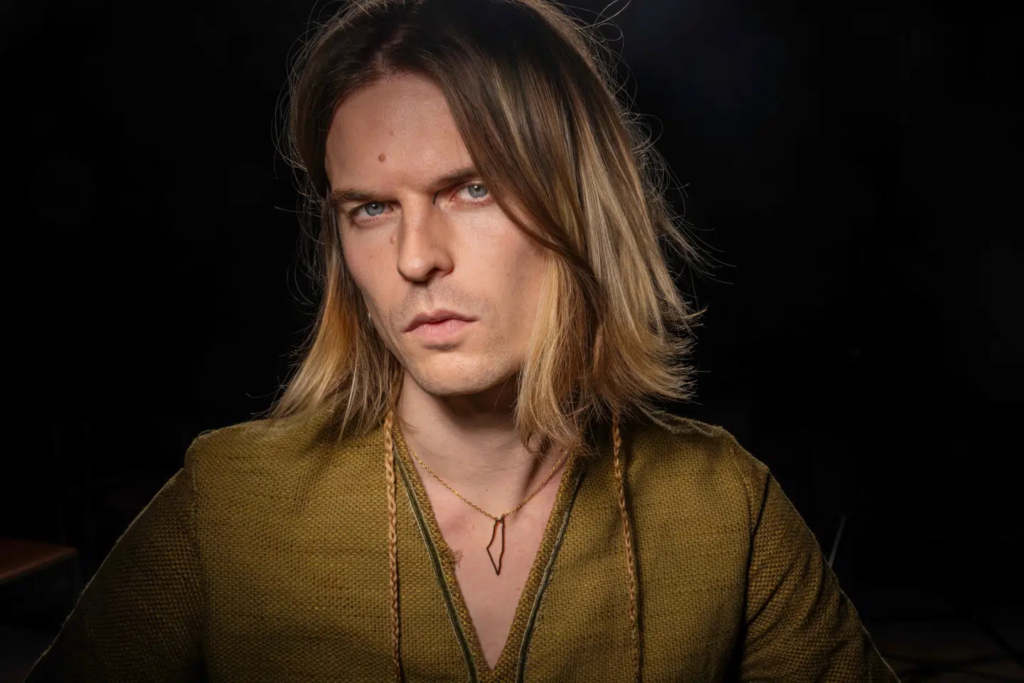
Before the First Feature, the Next One
The children’s film Broe is developing now might sound, at a glance, like a sharp turn after Sauna. The actual chronology says otherwise.
He started it before he ever made his feature debut, developed it for roughly three years, and was turned down at the time — in his account, because he was considered too young. He moved on and made Sauna instead. While that film was in the edit, his production company called and asked if he wanted to pick the earlier project back up. What looks like his next idea is, in part, a return to an old one.
The project is about children confronting transformation — kids who resist chaos, Broe says, precisely because they need a framework and have relatively little agency over the circumstances adults hand them. He points to Miyazaki and to a strain of Danish children’s-cinema realism from the 1970s and ’80s that he feels the country has quietly stopped investing in, and there’s a real edge of irritation underneath his description of it: if nobody else is going to make that kind of film right now, he intends to make, in his words, a new children’s classic.
The more personal thread is imagination itself. “I’ve always used imagination as an escapism, but also as a superpower,” he says — describing his own life and his protagonist’s in the same breath. It’s the same instinct that produced the “mirroring” observation earlier in this conversation, arriving in a completely different genre: a person giving an overwhelming feeling somewhere to go, whether that place is a camera pointed at himself as a teenager or a story about a child who needs one badly.
There’s one more project occupying Broe’s attention, though he’s careful to frame it only as a want, not a plan. Asked who in the wider world of film and culture deserves more recognition than they’ve gotten, he lands, after a pause, on Herman Bang — a late-nineteenth- and early-twentieth-century Danish writer, journalist, and stage director who described himself as having “a female soul,” whose reputation Broe calls “dusted” by time, and who died on a train in Utah in the early 1900s. Bang’s range across literature, journalism, and the stage is well documented; what isn’t yet a real project is any Broe film about him. “I have this want to work on a biopic,” he says — nothing further along than that. “I think these early icons — we should tell those stories as much as we can, and put them into a contemporary loop.” It sits alongside something he says almost in passing about the culture more broadly: that queer filmmakers treated for years as niche are visibly, finally, going mainstream. “Time usually helps people that were treated unfair, or lost, or forgotten,” he says.
Smarter Than the Plan
Near the end of our conversation, I tell Broe how frustrated I became with Johan by the end of Sauna — not because the film had lost me, but because it had done the opposite. By then I was invested enough in Johan and William, and in the real connection the film had built between them, that watching Johan repeat the same mistakes became genuinely difficult. Broe doesn’t defend the character so much as recognize him. “We’re never doing this hero’s journey,” he says. “We keep making the same mistakes in different versions, and sometimes we learn, and sometimes we don’t. He’s just having this huge wound — but extremely good intentions. I feel like that’s so relatable.”
I mention, too, how much I came to respect William’s composure in the film’s final stretch — a look that reads, essentially, as I see you, I understand you, and I am still going to stand where I stand. Broe agrees. It is perhaps the clearest moment in the film of a person managing something Johan still cannot: holding empathy and boundaries at the same time. That, too, echoes the idea Broe had offered earlier — that belonging to yourself, and to a community, has to come before you can safely belong to somebody else.
Broe’s own account of why any of this works circles back to where we started. “It just becomes — if you are honest with yourself, and you dare to go where it hurts, then it becomes extremely interesting what comes out of things,” he says. Not hurt as a destination. Hurt as the place curiosity has to be willing to go if it actually wants to find out what’s there.
His account of making Sauna is full of preparation — consultation, adaptation, hard conversations with collaborators, an editor’s precision, production decisions made under real pressure. What preparation can’t do is remove the need to run into something unexpected: a performer who makes an explanatory line unnecessary, an editor who protects an effect by dismantling the form built to deliver it, an old project that becomes possible again only because a different film changed what its director was capable of.
The next film doesn’t need him to know everything yet. If the movies really are smarter than we are in the moment, his job is simply to stay curious enough to listen when the next one starts talking.