' ' '
Atlantis Artist Spotlight
The Indirect Path
Written by Joshua Allen
Founder and Executive Director, The Atlantis Awards
“Why am I going the indirect path? Why don’t I just actually go after the thing that I actually want?” — Jon Peter Lewis

Based on a conversation with Jon Peter Lewis on October 9, 2026. This Spotlight discusses the production of My Name Is Ringo and accompanies the independent Atlantis Case Study, The Camera Arrives Last.
Quotations have been lightly edited for clarity and length.
Jon Peter Lewis was standing before roughly fifteen thousand people in Niagara Falls, opening for Eddie Money and performing a new album for the first time, when the achievement began to feel like evidence that he had chosen the wrong life.
He does not remember the album itself with the same rejection now. The objection was larger than the music. Years in the business had taught him to think of himself as a brand, and the moment onstage made the arrangement feel newly visible. “I didn’t like being the product,” he says. “It felt really confining.”
For someone who had reached national audiences as a finalist on the third season of American Idol, released albums and EPs, and later returned to televised competition with Ryan Hayes on The Voice, the realization did not arrive through a lack of opportunity. It arrived inside one. The audience was there. The record was finished. The machinery had worked. Lewis was looking at the result and asking why he had wanted it.
The answer took time to separate from the path that had produced it. One clue was sitting on his shelves. The collection he had kept, moved and catalogued since childhood was not primarily his music. It was his movies.
“I loved my movies from an early age,” he says. Even music had once contained an indirect plan: get onto television, become visible, and perhaps find a route into the movie business from there. Eventually the route itself became the question. “Why am I going the indirect path?” he remembers asking. “Why don’t I just actually go after the thing that I actually want?”
What he wanted was film.
The Collection He Kept
A career change can be described as a clean break only after enough time has passed to edit out the overlap. Lewis’s history does not divide that neatly. Performance did not become irrelevant when directing became central. Theatre, music and the experience of being watched all remain inside the filmmaker who eventually built My Name Is Ringo. What changed was the scale of the storytelling he wanted to control.
Music had placed his body and voice at the center of the work. Film could distribute authorship across actors, images, environments, sound, movement and time. It allowed him to build something larger than the persona required to promote it.
That distinction matters because Ringo could easily be introduced as a technical conversion story: a musician returns to school, discovers Unreal Engine and makes an animated science-fiction short. The chronology is accurate. The explanation is incomplete.
Lewis had been thinking about the film’s world long before he knew the software that might realize it. In 2010, while working as a door-to-door salesman in Midland, Texas, he began formulating the story and writing histories for the society surrounding it. He was already interested in stage parents and in the pressure placed on children when protection becomes entangled with an adult’s need. He was also drawn to cyberpunk, noir and the point where technology changes not only what people can do, but how they understand the world around them.
The resulting idea involved a child robotics thief, a compromised protector and a society learning to live beside sentient machines. Lewis could imagine it. He did not believe he could afford to make it.
“I never thought that I would be able to,” he says. The version in his head appeared cost-prohibitive by definition. It stayed with him anyway.
For more than a decade, then, Ringo existed as a destination without a practical route. That history gives Lewis’s eventual relationship with virtual production a different character. The technology did not hand him a premise to demonstrate. It encountered a story that had already been waiting for it.
Previs That Refused to Stop
At USC’s School of Cinematic Arts, Lewis entered a virtual-production class taught by John Brennan. The class was geared toward previs: constructing digital approximations that could help filmmakers plan what they would later shoot by other means.
Lewis saw another possibility.
“I was blown away by what was possible,” he says. “I was making a previs, and I was like, let’s just not even stop at the previs. Let’s turn that previs into the movie.”
He had never made animation. He had only begun using Unreal through the class. The lack of prior fluency did not make the process simple; it made almost every solution into a first solution. He learned the software while deciding what the film could become inside it.
The relationship moved in both directions. Lewis had initially written toward restraint, trying to keep the story small enough to manage. Once he began building, available environments and digital assets suggested possibilities he had not planned. He would encounter something useful, recognize how it might belong to the world, and fold it into the story. The tool that made the project feasible also kept tempting him to enlarge it.
“This could be bigger. This could be more,” he remembers thinking, until the expansion required a different instruction: “All right, stop. You’ve gone too far. Please stop.”
Even the human face entered through that negotiation. Lewis initially doubted that digital mouths would preserve speech convincingly enough. His contingency was structural rather than cosmetic: cover the characters’ faces and let them communicate telepathically. Once he saw the facial capture, the story changed. “Forget the masks,” he decided. “I want to see their faces.”
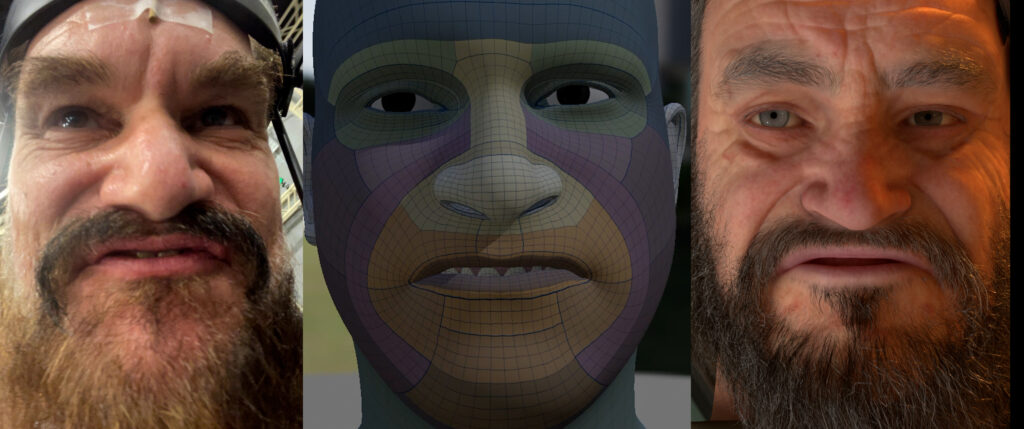
The technology had not merely improved the execution of an existing plan. It made a different dramatic plan possible.
That flexibility recurs throughout Lewis’s account of the film. A limitation becomes a character behavior. A shortcut becomes a mechanic. An available tool changes the scale of the world. The working method is not to defend the original conception from every new circumstance. It is to decide which discoveries belong.
Where Is the Camera?
The most technologically elaborate part of the production led Lewis back toward one of the oldest forms he knew.
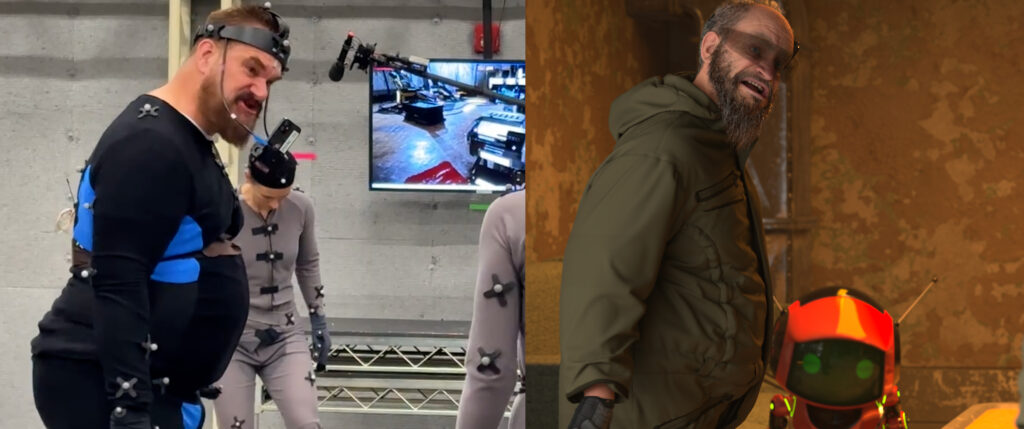
On the performance-capture stage, Kimberly Woods, Shelby Lewis and Ray Buffer could see preliminary versions of the environments they would eventually inhabit. Lewis blocked the positions of important objects and supplied physical props when the actors needed something to hold or manipulate. The room itself, however, remained closer to a black-box theatre than a conventional set.
Body, face, hands and voice were captured together. Lewis did not want to record isolated dialogue first and construct physical behavior around it later. He wanted performers sharing space, responding to one another and producing the scene as an event.
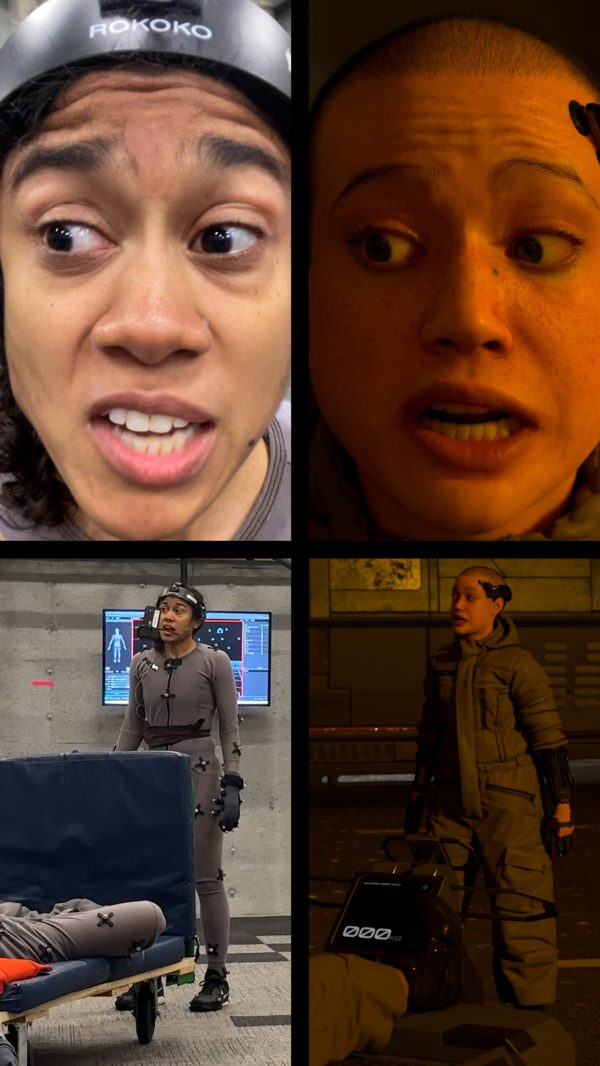
The camera was absent.
One actor eventually asked where it was supposed to be. Lewis’s answer was essentially that it did not matter yet. “Don’t even worry about that,” he remembers saying. “I just want you to focus on the actor.”
There was blocking, as there would be onstage, but no lens asking someone to cheat a look, protect a mark or preserve focus. The actors did not have to divide attention between the person opposite them and the equipment intended to record them. Lewis believed the performances became more honest because face, body and voice arose together.
The decision also reveals the practical mind working beside the artistic one. Lewis knew that he would carry almost all of post-production himself. Every production choice therefore had to answer two questions: does this help the scene, and can one person reasonably manage what it creates later?
Capturing a unified performance gave him material whose internal relationships were already intact. It shortened the stage days. It made later assembly possible without requiring him to invent a face, voice and body independently.
The advanced pipeline did not remove Lewis’s performance history from the process. It gave that history authority. He understood the value of actors being able to receive one another without a public-facing apparatus constantly interrupting the exchange. The person who once felt confined by being the product built a production in which performers could temporarily forget how the finished image would present them.
The image would come later.
What He Could Carry Himself
Lewis’s credit list on My Name Is Ringo is long enough to risk becoming its own mythology. In addition to writing and directing, he is credited across production design, digital humans, animation, cloth simulation, environments and look development, lighting, visual-effects supervision, post-sound supervision, sound design, re-recording mixing and Foley.
The easy version of that story is solitary mastery. Lewis gives a less flattering and more useful explanation.
He did not have the budget to hire a full team, and he dislikes asking people to work without compensation. “I don’t like being asked to do things for free,” he says, “and I don’t like asking others to do things for free.” When a task remained necessary and no paid specialist was available, he often absorbed it.
“If I want this thing done, I’m gonna have to do it.”
That decision produced an enormous personal workload. The film’s press kit describes him spending approximately twelve hours a day for a year and a half on the project. Learning became inseparable from finishing: animation, digital assembly, environment work, cloth behavior, sound and the numerous forms of cleanup required when captured bodies enter constructed spaces.
Doing many jobs, however, did not convince Lewis that he should do all of them.
His most revealing collaborators tend to appear precisely where he reaches the edge of his own knowledge.
I Don’t Know What I Don’t Know
Lewis could imagine action. Kerry Wong could tell him how bodies might actually accomplish it.
“I’m not a stunt person,” Lewis says. “I don’t know what I don’t know.”
Wong arrived as outside talent with prior motion-capture experience and assembled a stunt and rigging team that included Sam Ly. Lewis could describe what Ringo wanted, what kind of person she was and where she needed to go. Wong and Ly could convert that information into the mechanics of moving through space.
Their collaboration generated more acrobatic material than the film ultimately used. The omission was not a failure of execution. Lewis decided the performance was becoming too demonstrative for the character. Ringo is not trying to display mastery. She is trying to get from one place to another as efficiently as survival requires.
The cooler movement lost to the more specific one.
That choice says something about Lewis’s emerging discipline. Access to digital bodies and animation can invite a filmmaker to treat possibility as justification. The stunt team had supplied him with impressive options; he still had to ask whether Ringo would choose them.
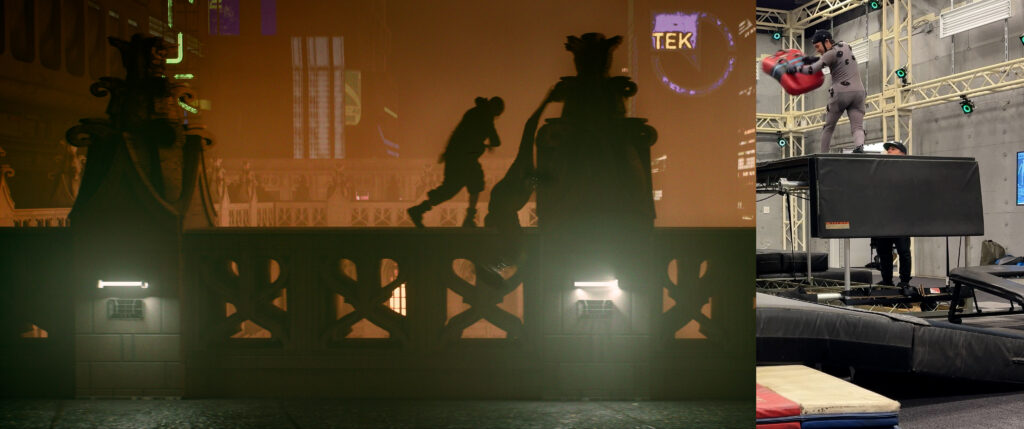
The motion-capture room created practical limits of its own. It had not been designed for the volume of wire work the team wanted, so apparatus had to be devised around the stage. Large actions were broken into useful parts: the beginning of a jump, the hand contact, the pull-up, the landing. The distances between them could be constructed afterward. Lewis and Wong were not pretending the room could contain the finished geography. They were determining which parts still needed a human body.
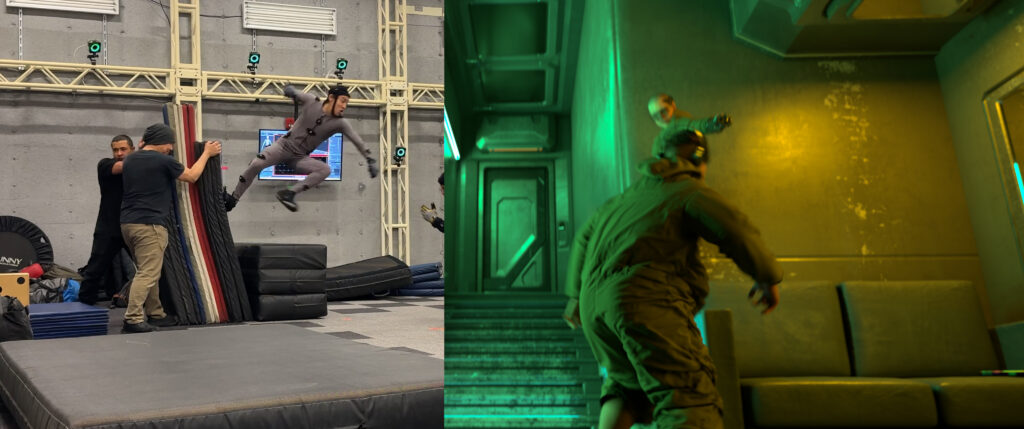
The stunt work became the production’s largest direct expense. Its value was not measured by how much of the captured acrobatics reached the screen unchanged. It gave Lewis a physical vocabulary, knowledgeable collaborators and a set of endpoints from which the digital work could continue.
Their conversations let the director dream up something he did not yet know how to execute. Wong knew enough to break the impossible action into solvable pieces. Lewis learned enough to preserve the character inside them.
The Instrument He Hadn’t Practiced
The limit Lewis recognized most quickly was cinematography.
Before Rocky Huang formally joined the camera work, Lewis tried building shots himself. He selected lenses, positioned virtual cameras and looked at the results.
“Bad,” he says. “It looked bad.”
He does not disguise the attempt as a useful early draft created only to communicate intention. He tried to be the cinematographer “for a hot minute,” saw that the execution was not working and reached a simpler conclusion: “I’m not the guy for this.”
That admission becomes especially meaningful beside everything he had already taught himself. Lewis had built the environments, assembled performances and learned enough animation to make the film exist. Technical familiarity with the world did not automatically give him the visual instinct required to photograph it.
Huang did.
Lewis describes camera work as playing an instrument: repetition becomes judgment, and judgment cannot be solved entirely through technical knowledge. Huang knew where the camera belonged. He could see what Lewis’s provisional images were trying to accomplish and replace their approximate intention with a visual voice.
His governing principle was restraint. A virtual camera can occupy positions no physical device could reach and move without ordinary limits. Huang proposed that they not pursue shots they could not feasibly achieve in reality simply because the software allowed them.
Lewis first used a controller to move the virtual camera near a useful starting position. Huang then operated through an iPad mounted in physical handles, sometimes on a fluid-head tripod and sometimes in handheld or shoulder configurations. The camera had no material presence inside the digital set, but the operator’s body and the physical resistance of the rig restored limitations that the software had removed.
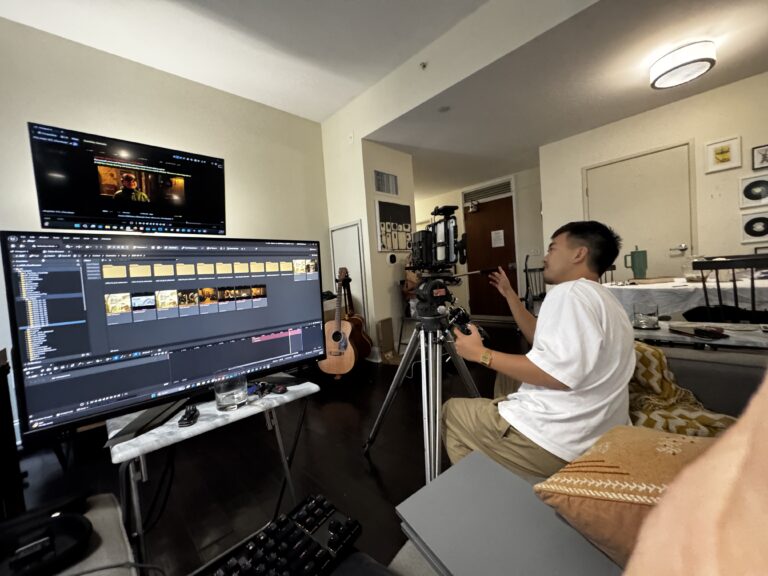
Lewis remembers watching Huang coordinate pan, tilt, virtual boom and dolly movement with an ease he could not explain through the apparatus alone. “Dude, you just did that whole thing,” he told him.
Huang’s answer was direct: “That’s what I do.”
The collaboration continued after the camera sessions. Lewis and Huang returned to relight many scenes together, and Lewis readily identifies Huang as the stronger lighter. He gives that credit without treating it as a reduction of his own authorship. The ability to build a world did not require him to claim that he had found its best light.
Editor Matthew Berger becomes another major visual voice in Lewis’s account. Berger received rendered takes and cut them through a largely traditional editorial process. The difference was what could happen when the edit exposed an absence. A missing reverse or better angle did not necessarily require a reshoot with performers and locations. Lewis could return to the constructed world and generate another view while drawing on the camera language Huang had established.
The pipeline made unusual solutions possible. Lewis still needed collaborators who knew which solutions were worth choosing.
What the Number Leaves Out
The reported production budget for My Name Is Ringo was $3,000. Lewis understands why that figure attracts attention. He is equally clear that it does not describe what replacing the production’s resources and labor would cost.
USC’s student-production arrangement with SAG made it possible for Lewis to work with professional performers at a level that would otherwise have been difficult to reach on a student budget. Under that agreement, compensation is deferred rather than waived; if the film is distributed, the performers are paid according to the agreement’s terms. Kimberly Woods, Shelby Lewis and Ray Buffer entered the production as professionals, and Lewis speaks about their contribution with particular gratitude. The university also provided access to a motion-capture stage, while much of the crew consisted of fellow students working within the school’s production ecosystem, often receiving academic credit. That community mattered as much as the facilities. Huang and Berger were fellow students whose skill and willingness materially changed the finished film.
Then there was the computer. Lewis built a workstation for the project and “spared no expense” on it. That equipment does not appear in the submitted budget. Neither does the replacement value of the stage, the performers, the student labor or the year and a half Lewis spent carrying most of post-production himself.
“Free, I guess that’s the price of tuition,” he says of the stage. “None of it’s actually free.”
The distinction is more than budget clarification. It returns to his reluctance to build a film around extracting unpaid labor from people who could not afford to provide it. Lewis took on multiple departments partly because he lacked money, and partly because he did not want every missing dollar to become someone else’s uncompensated obligation.
That does not turn the production into a solitary act. The actors entered knowingly through the university arrangement. Students contributed within an educational system that gave them credit and relationships. Outside specialists were brought in where the work demanded them. The $3,000 figure remains accurate as direct spending. It simply cannot carry the whole cost story by itself.
The film exists through an institutional ecosystem, contributed labor, personally owned technology, specialist knowledge and one filmmaker’s willingness to spend an extraordinary amount of time closing the remaining gaps.
A smaller number made the production possible. It did not make the production small.
A Tool Must Have a Job
Lewis would still like to see what this world looks like in live action. He also estimates that achieving the same scale that way would require tens of millions of dollars. Given less than that—which he recognizes as the likelier circumstance—he would preserve much of the pipeline he has already built.
The changes he identifies are specific rather than revolutionary. Optical capture struggled with hands; next time, he would investigate another system rather than simply accept the same cleanup burden.
He has also experimented with whether AI might eventually function as a final corrective layer after the human performances, stunt work, animation and photography are complete. Those experiments came after My Name Is Ringo had already reached its final cut. No generative-AI material appears in the finished film.
The tests were modest. Some mouth movement became cleaner. Some hair rendering improved. The gains were not transformative, and Lewis is not interested in imposing a recognizable AI aesthetic over the work.
“I wouldn’t be interested in changing the overall aesthetic very much,” he says. “I’m not a fan of the AI look.”
His position is neither technological devotion nor refusal. It is conditional. Does the tool preserve something valuable? Does it repair a limitation without replacing the process that gave the image its meaning? Does it help tell the story?
“I’m interested in storytelling, personally,” he says. He does not think AI is especially good at doing that by itself. He expects technological change to remove some jobs and create others, as other large industrial transitions have done. The appropriate response, in his view, is examination rather than panic.
“It shouldn’t be feared,” he says. “I think it should be explored.”
The qualification matters. Exploration is not surrender. Lewis’s relationship with technology throughout Ringo is practical enough to include rejection. He abandons the masks when faces work. He discards acrobatics when they do not belong to the character. He invites a cinematographer when his own images fail. And only after the film is finished does he test whether AI can improve certain rendering artifacts—then readily acknowledges that the difference is not yet large enough to inspire much enthusiasm.
The tool does not receive credit for existing. It has to earn a place in the work.
The World Stays Open
Lewis’s next use of the Ringo pipeline is not another short film—at least not yet. It is a game.
Because the environments and characters already existed inside Unreal, the world remained available after the film was finished. Lewis began developing a companion experience centered on Harvey during the interval between his crash into the train and his later encounter with Ringo. The player guides him through the city, trying to escape a maze whose ending returns to their first meeting.
Lewis has made the route difficult enough that traversing the city from one end to the other took him nearly three hours even though he knew where he was going. He calls his own design “diabolical” with evident pleasure. Development paused while he concentrated on the film’s festival run and while a failed GPU returned to NVIDIA, but he intends to resume.
The project extends Harvey’s story. It also reveals what Lewis has built beyond a single finished movie.
In conventional production, the city would disappear through dismantled sets, surrendered locations and wrapped crews. Here it remains navigable. The assets created for one form can become the setting for another. A world originally considered too expensive to realize can now persist after the credits and invite a different kind of participation.
Lewis does not yet know the exact scale of what follows. “I’m doing more of these,” he says. “I don’t know exactly what that’s going to look like.”
The uncertainty no longer resembles the one he faced in Midland. Then, he had a world and no credible method for reaching it. Now he has a method whose next destination is still taking shape.
The Path Becomes the Method
Lewis once imagined music as a route into film. Years later, previs became a route into a finished short. Theatre practice entered a performance-capture volume. Human stunt fragments crossed distances supplied by animation. A game engine became a set. An iPad became a camera. A film became the foundation of a maze.
The path remains indirect in almost every practical sense.
The difference is that Lewis now knows what the detours are serving.
His work on My Name Is Ringo does not suggest a filmmaker interested in technology for its own novelty. It suggests someone who will learn a system until it can carry an idea, recognize when another artist understands part of that system better, and let the process change without surrendering the story it was meant to tell.
The performer has not disappeared. He is present in the attention paid to actors working together. The musician has not disappeared either. Lewis hears camera operation as an instrument that requires practice, and he understands collaboration through the difference between knowing what a tool can do and knowing how to play it.
What has disappeared is the need to make himself the product.
The world can stand in front now.
The indirect path is no longer a delay on the way to the work. It is how Jon Peter Lewis makes the work possible.