
' ' '
Atlantis Artist Spotlight
“We are not daredevils.”
There is a version of this story that runs: kid falls in love with the movies, chases the dream, earns a career through nerve and hard work. It’s a satisfying shape. It is also not quite what happened.
The real story starts on a front lawn in Utah, and it isn’t about passion. It’s about belief.
Doug Coleman was eleven or twelve years old when he and a friend smeared ketchup around their mouths and staged a fight in front of his parents’ house. They committed to it — enough that a passing car stopped, and two grown men climbed out to pull them apart. Doug and his friend dropped the act immediately. Nobody was hurt. There was no real fight. But the two strangers had believed it.
“I knew I was onto something at a very young age,” Doug told me.
Long before he became a champion magician, stunt performer, coordinator, and voting member of the Academy of Motion Picture Arts and Sciences, Doug Coleman had already found the idea that would define everything after it. The ketchup didn’t need to be blood. The fight didn’t need to be real. It only needed to be believed.
That instinct carried him from a front lawn in Ogden to some of the largest productions in modern cinema — Cape Fear, The Terminal, The Revenant, Sicario: Day of the Soldado, Westworld, Mad Max: Fury Road, Sully, One Battle After Another, Disclosure Day, and the upcoming Paris Paramount. But the credits are only evidence. The more interesting story is how the boy with ketchup on his chin became a man who has spent nearly fifty years engineering believable impossibility — while insisting, at every stage, that the illusion has to serve something human.
A Magician Learns to Build High-Risk Illusions
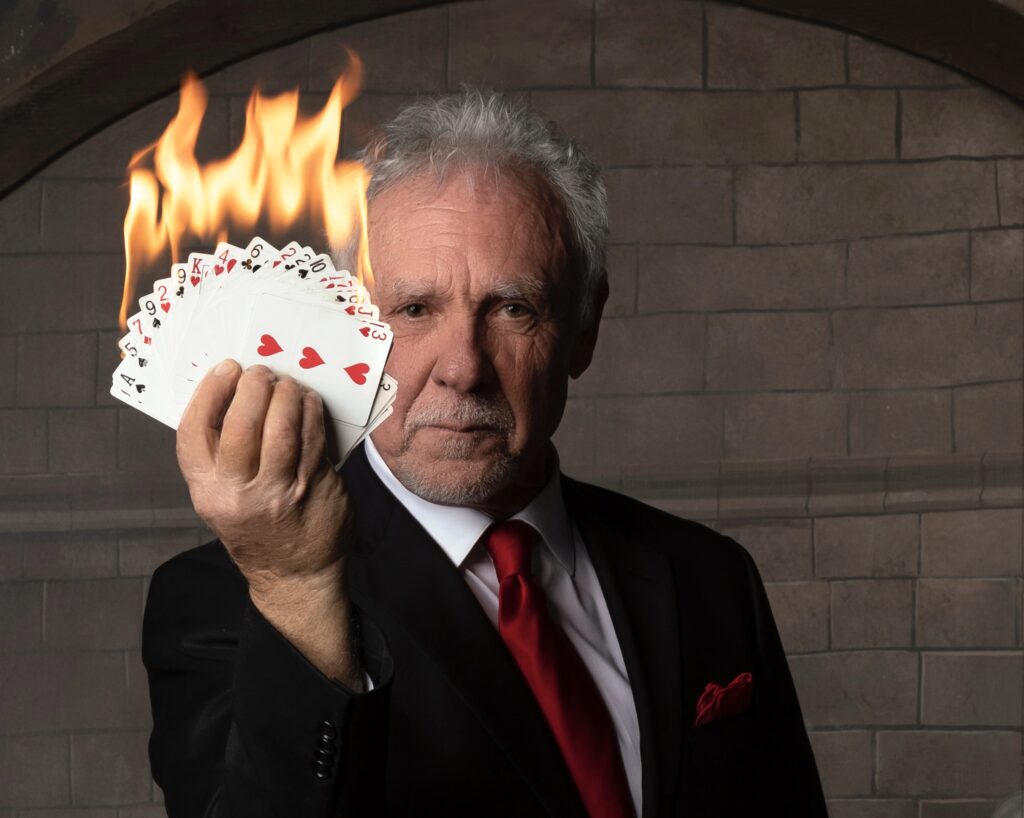
Doug has been a magician since he was six. In his own account, stunt work was never a separate career bolted onto the first one — it was where the first one led.
“I went from illusions to high-risk illusions,” he said. “That’s what stunt work is to me.”
Growing up in Utah, he built a physical vocabulary broad enough to sound invented when you list it out loud: demolition derby champion, diving champion, competitive trampoline, aerial acrobatics instructor, mogul-skiing judge, mountain climber, skydiver. The ability was real. The ambition, from early on, was cinematic.
At fourteen, he told his parents he was camping in the mountains outside Salt Lake City. Instead, he and a friend hitchhiked toward California, hopped a train in Elko, Nevada, and reached 20th Century Fox roughly two and a half days later. The studio wouldn’t let them through the front gate, so they climbed the fence instead. For the rest of the day, two teenagers wandered the lot trying to look like they belonged there — onto soundstages, up into the grids, watching a factory of illusion assemble itself in real time.
“That was my eye-opener,” Doug said. “A studio lot, and cameras, and people. I’ve never looked back.”
There was no clear apprenticeship waiting for him at home. Utah saw the occasional production come through, and he chased whatever work existed. Looking back, he considers the absence of a mentor a kind of gift.
“I didn’t really have anybody taking me under their wing to teach me the ropes,” he said. “Looking back on it, I’m kind of thankful for that, because it forced me to learn on my own — to take my own chances and figure stuff out on my own.”
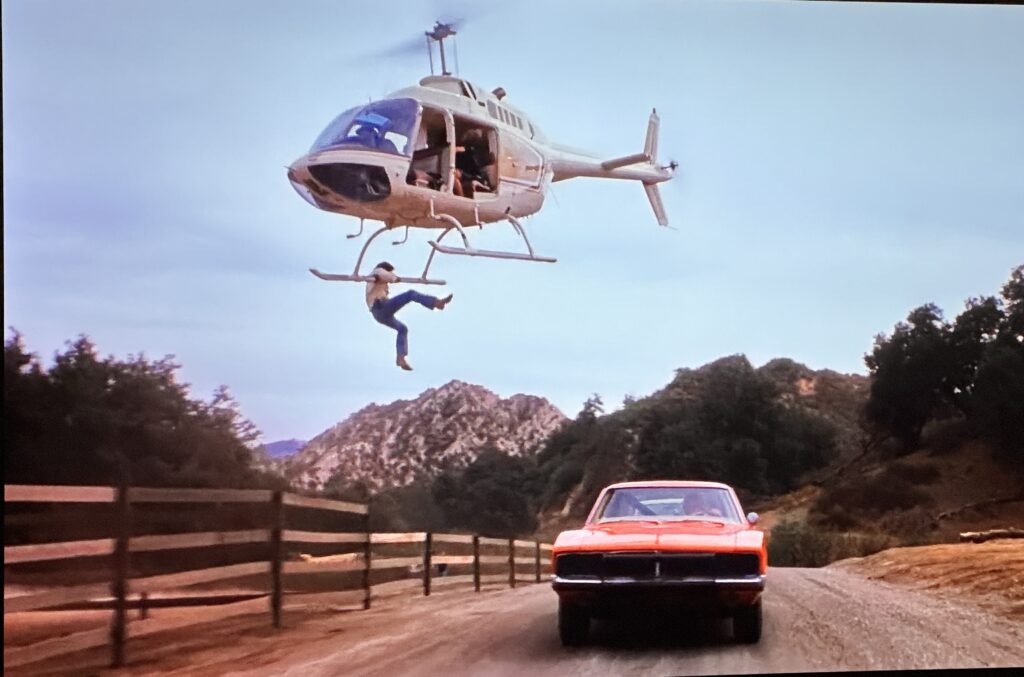
The break, when it came, arrived through Loren Janes — the legendary stuntman best known as Steve McQueen’s longtime double. Janes had seen Doug throwing triple backs on a trampoline and remembered it. Years later, needing someone who could ski and flip on command for The Nude Bomb: The Return of Maxwell Smart, he called. That job got Doug his SAG card. Nearly three decades later, Doug would return to the same franchise’s DNA as stunt coordinator on the 2008 Get Smart reboot — a small, quiet loop most people would never think to trace.
That early isolation shaped a philosophy he still holds. Doug doesn’t want to reproduce someone else’s sequence. He calls it being “a cover band” — for other coordinators, other films, other magicians — and he is wary of it the way some directors are wary of cliché.
“I want it to be like that bear fight in The Revenant,” a director will sometimes say, meaning it as a compliment.
Doug hears it as a warning sign. The moment a production starts by recreating an existing answer, it forfeits the chance to find its own.
“I don’t want to be like that,” he said. “I want to create my own.”
Trust Starts With Reading the Room
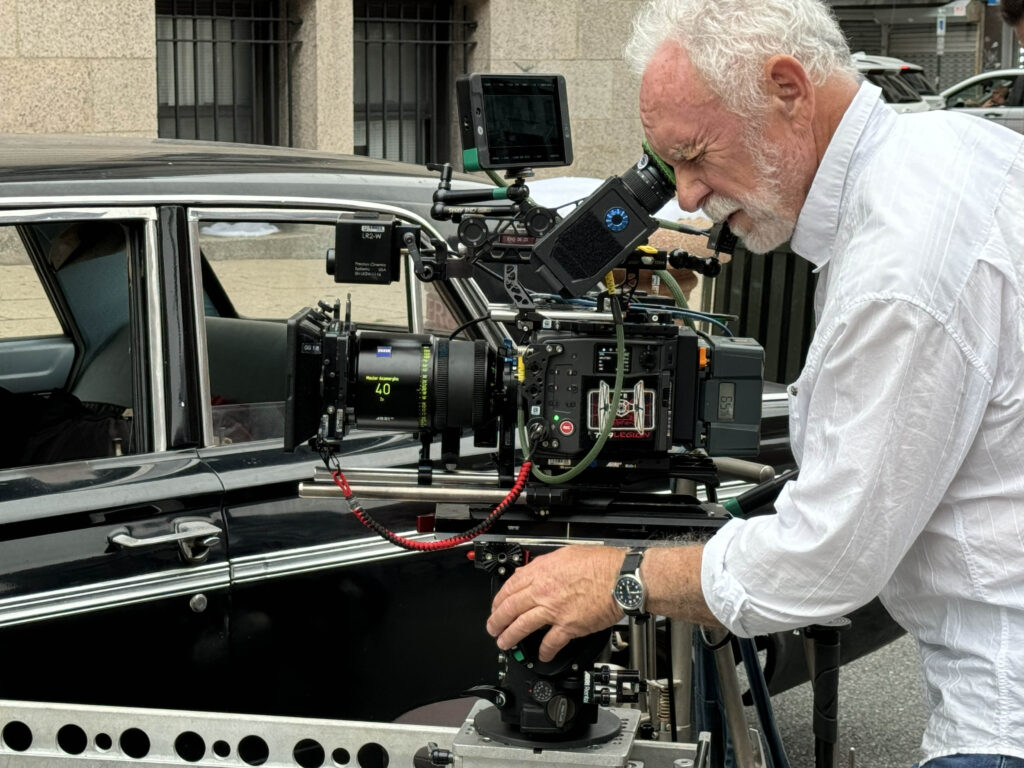
Doug begins every job the same way: with the script. He reads, highlights, flags complications, and starts building a budget. But before any of that is technical, it’s about character.
“I see little red flags that could, in my mind, be enhanced for the character and for the story,” he explained. “We want to leave a lot of room for this guy to develop his character — to see how he’s going to behave through these things.”
A fight, in his hands, is not a list of strikes. A chase is not a sequence of obstacles. The action has to belong to the person doing it, which means Doug’s real subject is rarely the stunt — it’s the actor performing it.
He talks about “reading the room” less as an instinct than as a practical skill. Meeting a performer for the first time, he’s watching how they move, how fast they absorb instruction, what unsettles them, what they’re actually capable of once someone shows them how.
“I assess their ability, and I have to do that quickly,” he said. “I work with her for maybe five or six minutes, and I know, man, she’s going to have this.”
The double still shows up — insurance for the performer, the schedule, the production — but Doug knows within minutes whether the real thing belongs on camera. That recognition is where trust starts.
“They know that I am there for them,” he said, “to help them in their insecurities and their physical abilities.”
Asked what directors like Clint Eastwood, Martin Scorsese, Alejandro G. Iñárritu, and Steven Spielberg have in common, Doug didn’t pause.
“Trust.”
Once a director genuinely trusts the department head, he said, everything opens up. “That’s the best feeling in the world. Then you have the freedom to do 110 percent.” The trust isn’t passive — it’s an invitation to contribute, and Doug treats it as the highest currency in the job.
The Difference Between Authorship and Facilitation
After nearly a century of the Academy Awards, stunt design will finally get its own category in 2028, honoring films from 2027. Doug — an Academy member for more than twenty years — welcomes it, but not without a reservation.
“I think it’s great,” he said. “But it’s a double-edged sword for me right now.”
His worry isn’t about recognition. It’s about what gets recognized. He wants the award to go to creative stunt work, not simply the ability to execute someone else’s instructions well.
“I want to see somebody get an Academy Award for their creative stunt work, rather than being a facilitator and just being told by somebody, ‘This is what I want you to do.'”
The distinction sounds small until you watch him apply it. On Sicario: Day of the Soldado, the production had envisioned an elaborate bathroom fight for Benicio del Toro’s character — an extended struggle, breakaway plumbing, physical business stacked on physical business. Doug started prepping it the way he’d prep anything: breakaway materials, water direction, camera safety.
Then he stopped.
The sequence would have worked. It just wasn’t true.
“The more I thought about it, the more I thought about his character,” Doug said. “I just had this gut feeling: I’ve got to call him.”
He met del Toro for coffee and laid out the planned scene. Then he offered something smaller: You come in. You look at the guy. You shoot him through your jacket with a silencer. You turn around and walk out.
Del Toro agreed, and the change was made.
The elaborate version disappeared. The simple one stayed — not because it was cheaper, and not because Doug lacked the ability to build the bigger sequence, but because restraint was the more honest choice. The best stunt, in this case, was the one they chose not to do.
The Invisible Architecture Beneath the Spectacle
Ask Doug what myth about the job he’d most like to eliminate, and there’s no pause at all — of everything we covered, this is the one answer that arrived before the question had fully landed.
“We are not daredevils,” he said. “We take the time to eliminate every possibility of injury.”
What looks like chaos on screen — a car crash, a fall, a collision — is underwritten by a long list of unglamorous decisions: tire pressure, track temperature, surface material, weight distribution, rehearsal, redundancy. “We don’t just hop in the car, roll the dice, and take our chances.” The danger is visible. The architecture protecting the performer from it isn’t, and Doug considers that invisibility part of the craft, not an accident of it.
Sometimes the job means telling a director no — carefully. His background in magic gives him a method for it.
“I hate to use the word manipulate,” he said. “Or forcing a card. I have to force a card sometimes.”
On Cape Fear, working as a burn specialist, Doug needed to steer a director toward the safest version of a full-body fire effect without simply overruling him. So he built five options — blue flame, orange flame, heavy smoke, etc — plus the one he already knew was correct, and let the director choose. The director chose the one Doug intended all along. Like a good magic trick, the illusion of choice did the work that an argument couldn’t have.
Other decisions left no room for sleight of hand. On Action Jackson, a stunt called for a performer to fall from scaffolding through a breakaway skylight while fully engulfed in fire, wearing air tanks, functionally blind, before landing roughly sixty-seven feet down on an airbag. It was technically possible. It was also narrow enough that a small mistake could become a catastrophic one. Rather than ask someone else to accept that risk, Doug did it himself, trusting his own trampoline background and spatial awareness over anyone else’s.
“I worked it out by just doing it myself,” he said, “because I had the confidence.”
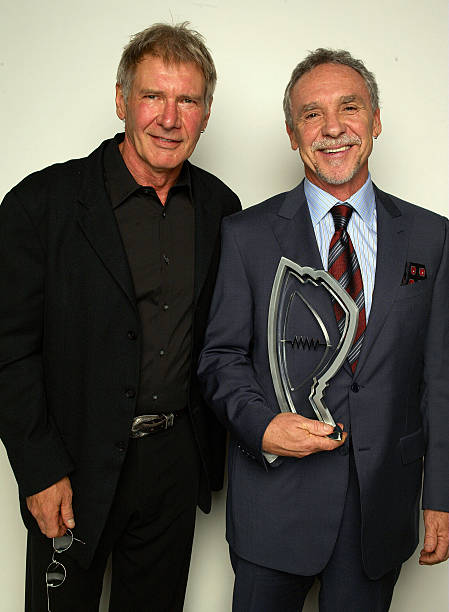
With Harrison Ford — who liked doing his own stunts, and usually could — the answer sometimes had to be no anyway.
“You might be able to do it,” Doug told him, “but I want to go home tonight with a job coming back tomorrow.”
The star’s willingness didn’t outweigh the production’s responsibility. That isn’t caution for its own sake. It’s stewardship.
Twenty-One Projects, Twenty-Three Years
Brian Machleit first met Doug in 2003, on The Haunted Mansion — a young stunt performer standing at the edge of the department with an open notebook, absorbing whatever he could about rigging.
“He was like a sponge that day,” Doug said. “He would look at everything and just soak it all in. He read the room perfectly.”
Twenty-one shared productions and twenty-three years later, Machleit — now a stunt coordinator in his own right — brought Doug onto Steven Spielberg’s Disclosure Day, and later described the reunion as a full-circle moment. Doug’s version of the same story is less about symmetry and more about gratitude.
“I love Brian,” he said. “I’m just very grateful to all my friends and collaborators, because that’s what this is. It’s a collaborating business.”
Doug had worked with Spielberg before, on A.I. Artificial Intelligence and The Terminal, and had turned down other Spielberg projects when he was already committed elsewhere. Coming back to a Spielberg set through someone he’d watched grow up in the department — rather than through the director directly — gave the return its own particular weight.
Brian no longer needed to be shown the room. He was running it.
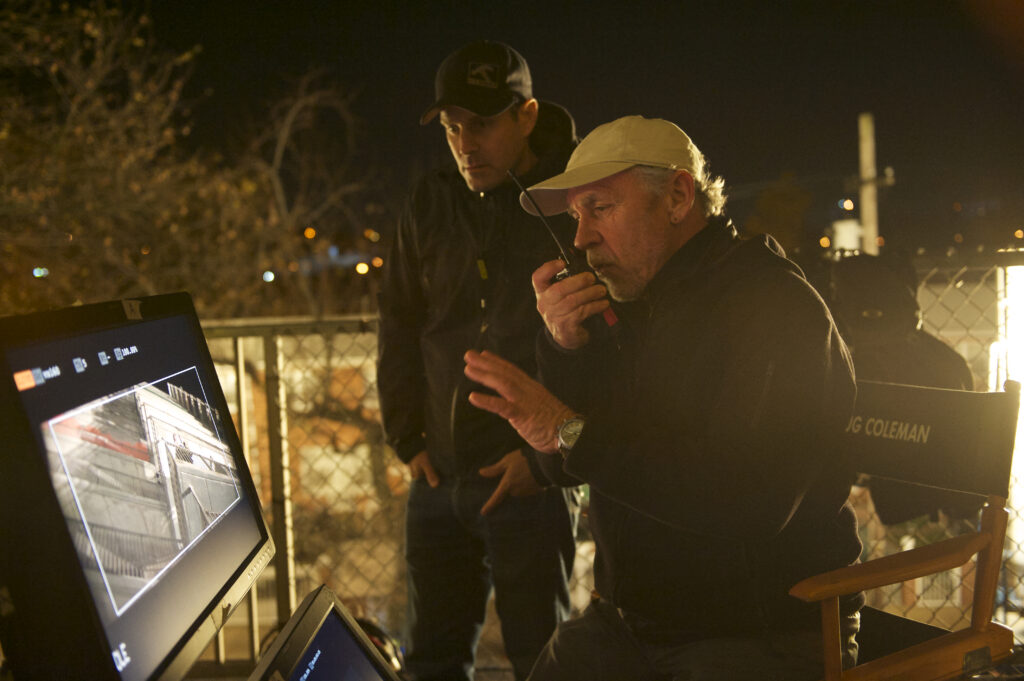
A similar philosophy shaped Doug’s relationship with his daughter, Whitney Coleman. Whitney grew up around the business, built real physical skill early, and told her father plainly that she wanted to be a stunt performer. Doug encouraged her education — insisted on college before anything else — and offered advice whenever she asked for it. What he refused to do was make her career for her.
“I never made one call,” he said. “Ever.”
He never phoned a coordinator on her behalf. He never let his name do the work. Whitney didn’t always understand the restraint at the time. Eventually, she did.
“I love the fact that people would call me up and say, ‘I didn’t know Whitney was your daughter.'”
One story captures what that restraint produced. Whitney once asked to borrow the family truck and boat trailer for a shoot. Weeks later, she showed Doug footage of herself sliding a truck and trailer precisely into a mark — a maneuver she’d taught herself by quietly reversing the same rig around their cul-de-sac and into the driveway, over and over, for weeks, so that no crew would ever have to reset it between takes. Nobody had asked her to prepare that way. She simply understood, on her own, what the job required.
Mentorship, in Doug’s telling, succeeds exactly when the student stops needing the mentor’s name.
The Coleman Household
Doug’s wife, Eliza Coleman, has built a career every bit as substantial as his own — a working stunt performer whose own credits run from Independence Day to Spider-Man to The Perfect Storm. Whitney followed both of them into the business; their son, Chase, grew up around the same sets with a lighter involvement in the work itself. Between the four of them, conversations that would sound extraordinary anywhere else are, in the Coleman house, simply Tuesday.
At the time of our conversation, Doug was coordinating stunts on Nancy Meyers’ Paris Paramount at Warner Bros., while Eliza was coordinating another production on the same lot, with her office in the same building just above his.
“We rarely talk about movies,” Doug said. Once in a while, one of them will float a question about staging a car, or a physical problem that needs solving — but the industry doesn’t dominate the house simply because it built the house.
Eliza, at the time, was away competing in a three-day rally event in Colorado.
“I have a pretty cool family,” Doug said. It read less like a boast than an understatement. What makes the Coleman household remarkable isn’t the combined credit count. It’s the way judgment — about risk, preparation, physical storytelling, professional conduct — has passed between them without ever needing to be taught directly. In a family like this, a story about making Leonardo DiCaprio look mauled by a bear doesn’t register as extraordinary. It’s just how the day went.
The Film That Asked Everything
Asked which production means the most to him personally, Doug didn’t hesitate: The Revenant.
Eleven months, under conditions he still describes carefully. By his account, the shoot wasn’t for everyone — not everyone who started the project was still there when it wrapped.
Doug thrived in it.
“Doing eleven months on The Revenant was the most challenging and interesting thing I have a feeling I will ever get to do.”
The hardship wasn’t the draw by itself. What made it worth eleven months in the cold was the trust that came with it.
“I had Alejandro’s trust,” he said. “I had his trust to create things.”
That trust let Doug respond to the environment and the character rather than simply execute instructions — the difference, again, between facilitation and authorship. He doesn’t expect another production to offer that exact combination of scale, hardship, and creative latitude.
“I will never have that opportunity again.”
He doesn’t say it with any regret. He says it like someone counting himself lucky to have been there at all.
The Audience Remembers the Feeling, Not the Mechanism
Ask Doug how he wants to be remembered, and he’ll gently correct the premise. The only time he actively wants an audience thinking about Doug Coleman is during a magic show — and even then, his name is beside the point.
“I don’t want them to think about Doug Coleman,” he said. “I want them to think how I made them feel.”
They’ll forget the mechanics. They may forget which trick it even was. But if they remember being astonished, or unsettled, or moved, the performance is still doing its job years later.
The same logic governs the film work. Doug doesn’t need an audience to know which coordinator built a sequence. He loves the process and the people who build it with him. If his name ends up attached to the result, he’s glad of it — but that was never the point.
Midway through our conversation, Doug asked me to think of a two-digit number between ten and ninety-nine. I picked sixty-seven. He turned over a note he’d already written before I answered.
Sixty-seven.
I still don’t know how he did it. That’s precisely the point — the mechanism disappears, and what’s left is the experience.

Creativity, Collaboration, Character
Doug’s advice for the next generation of stunt performers is short: stay creative, stay your own person.
“It’s a creative industry,” he said. “It’s a collaborative industry. It’s a social industry.”
He has no patience for the idea that the job is fundamentally about fearlessness, and no interest in action for its own sake. He’s suspicious of imitation in any form. And he holds the technician, the performer, and the production assistant blocking traffic to the same standard: what matters is whether they gave the day everything they had.
“There’s a thousand people on a movie set that are all doing a job,” he said. “If they’re into it and they’re giving 110 percent, that’s the achievement.”
After nearly fifty years of engineering things that shouldn’t be possible — fire, falls, collisions, chases — Doug’s deepest lessons aren’t about any of those mechanics. They’re about people.
“You’re not just talking to each other,” he said. “You’re feeling each other.”
That, he says, is the most satisfying part of the job: the moment someone realizes they’ve actually been heard.
“I know it’s not about filmmaking,” he added.
Of course it is. Filmmaking is the people. The trust. The listening. A thousand individual contributions disappearing into a single shared illusion.
Standing Ovation
At fourteen, Doug Coleman climbed a studio fence because he needed to understand how movies got made. Decades later, he’s helped audiences believe in burning bodies, impossible falls, violent collisions, and a bear attack that has become part of the language of modern cinema. But the boy on the front lawn never entirely left. He’s still staging the fight. Still watching the audience’s face. Still asking exactly how much preparation it takes before anyone can safely believe the impossible.
Near the end of our conversation, I asked how he signs off a magic show.
“With a standing ovation,” he said, and laughed.
And that was more or less how our own conversation ended — Doug Coleman disappearing back into a career built on making the mechanism invisible and the experience unforgettable, leaving me to do the only thing that seemed appropriate:
Stand up, and applaud.