
' ' '
Atlantis Artist Spotlight
Written by Joshua Allen
Founder and Executive Director, The Atlantis Awards
“I’m toying with the third rail of a character—getting to a place that’s dangerous, because that is how I know I’m engaged with something real.” — Chris Stack
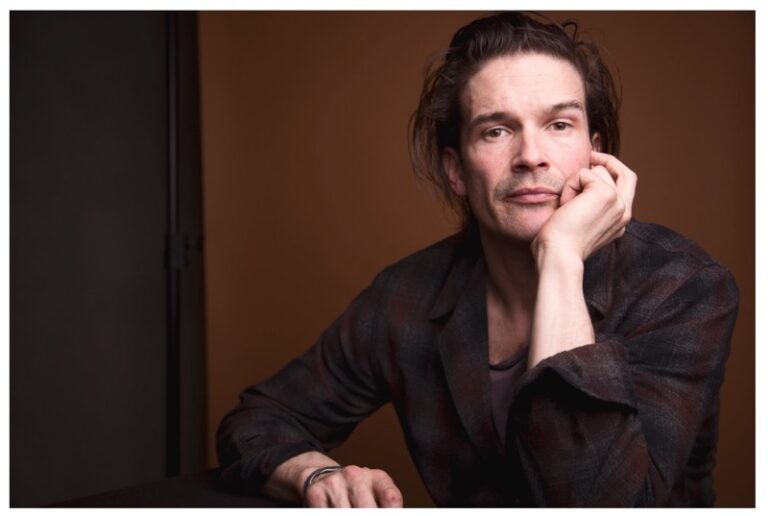
Quotations have been lightly edited for clarity and length.
Chris Stack is explaining what he wants from a performance when he reaches for an electrical metaphor.
He does not want the work to become about him. He is not interested in turning a character into an opportunity for public confession or displaying his own emotional life as proof of seriousness. But he does want to move close enough to something private that the performance begins to feel dangerous—close enough to touch what he calls the character’s “third rail.”
“That is how I know that I’m engaged with something real,” he says.
Later, he reaches for another description. Working on someone else’s project allows him to air some of his own dirty laundry through somebody else’s words. The writer has supplied the circumstances, the history, the behavior and the language. Stack can draw upon whatever part of himself gives those things life without having to identify its source. He can tell the truth and keep his secrets.
The character becomes both conductor and insulation.
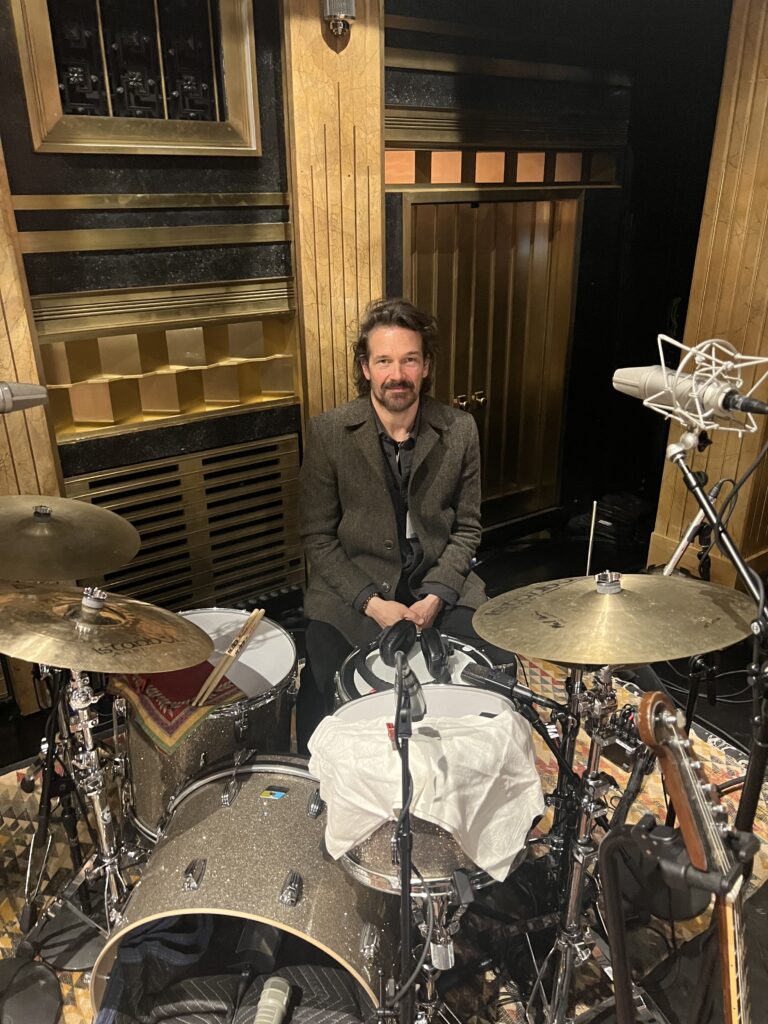
That relationship between danger and control runs through much of Stack’s work. In Midday Black Midnight Blue, he plays a man whose emotional life has been compressed almost beyond visibility, revealing grief not through constant expression but through the effort required to contain it. In David Adjmi’s Stereophonic, Stack sits behind a drum kit as Simon, maintaining the tempo of a band whose creative breakthrough and personal disintegration are occurring almost simultaneously. Across a long stage career, he has repeatedly played men attempting to hold together a marriage, a family, a recovery community, an artistic circle or a room—even when their own stability is less certain than it initially appears.
The public version of his career might begin with Stereophonic: the Broadway debut, the record-setting Tony nominations, the Theatre World Award, the cast learning to perform as a real band. But the drummer arrived after more than two decades in New York theatre, roughly twenty years at the Actors Studio, years of film and television work, a daytime soap, small productions, large institutions and an enormous amount of labor that did not become less real because fewer people were watching it.
Broadway put Chris Stack behind the drums.
He had been learning to hold the beat for years.
The Drummer Was Already There
Stack first auditioned for a developmental workshop of Stereophonic in 2019.
He had played music since his teenage years in Indianapolis, where he performed in productions of The Crucible and Carousel at Park Tudor School, but much of his adult drumming had become recreational. He understood the instrument. He also understood that he was rusty. When the workshop opportunity appeared, he booked studio time and practiced intensely — and then a scheduling conflict, a prior job commitment, made it impossible for him to participate. He has described the loss, plainly, as heartbreaking.
The opportunity seemed to have passed, but Stack made a decision that would become more important than the lost workshop: he did not want to be caught flat-footed if the project returned. He kept practicing. When Stereophonic moved toward its world-premiere production at Playwrights Horizons years later, he was asked to audition again — this time performing original music by Will Butler alongside Butler and music director Justin Craig, and reading scenes for the show’s director, Daniel Aukin.
Stack does not claim that those years transformed him into the finest drummer available. His usefulness existed at the intersection. The production needed performers who could build detailed, psychologically credible characters while playing live music well enough for an audience to accept the unnamed group as one of the important rock bands of its era. The actors could not mime competence around a recording. Their musicianship had to survive observation.
Stereophonic premiered Off-Broadway in 2023 and transferred to Broadway the following year. The Broadway production received thirteen Tony Award nominations — the most ever for a play — and won five, including Best Play. Stack received a Theatre World Award for his Broadway debut and shared the Drama Desk’s Ensemble Award with the original company. He later continued as Simon in the West End production at the Duke of York’s Theatre alongside fellow original cast members Eli Gelb and Andrew R. Butler.
Those achievements make an attractive culmination, but they do not explain why Stack belongs inside the play.
Simon is the drummer and the group’s unofficial manager. He keeps track of the album, the schedule, the morale and the increasingly unstable people responsible for completing both. His wife and children remain across the Atlantic while the recording process extends far beyond what he promised them, and if Simon is ultimately forced to choose between protecting his family and finishing the record, Stack believes the character will choose the record.
The drummer holds time for everyone else while losing time somewhere else.
That function extends beyond the script. Since the Off-Broadway run began in August 2023, Stack has performed six shows a week — and by his account, the nightly repetition changed something beyond his hands. His drumming sharpened, but the more significant shift happened in his ear: in his ability to hear what another musician was doing, understand his place inside the larger sound and respond without abandoning the structure.
That is also a description of ensemble acting.
A drummer can affect the shape of an entire performance without claiming its melody. He receives information, answers it and maintains enough structure for everybody else to take risks. He must remain exact without becoming rigid and present without insisting that attention stay with him.
The role did not teach Stack those instincts from nothing. It made visible the discipline his career had already required.
Twenty-Six Years Before Broadway
The neat version of Stack’s story begins at Playwrights Horizons and proceeds to Broadway.
His version is longer.
He graduated from Park Tudor School in Indianapolis in 1991, where music and theatre were already part of his life, and from Lewis & Clark College in Portland in 1997 with a degree in English. He later trained at the Actors Studio Drama School at Pace University and established himself in New York. By the time Stereophonic reached Broadway, he had been living and working there for close to twenty-six years.
One of his earliest documented Off-Broadway roles came in Liz Tuccillo’s Joe Fearless at Atlantic Theater Company in 2000. Over the years that followed, his theatre credits accumulated through a significant portion of New York’s new-play ecosystem: Playwrights Horizons, Roundabout, Signature, Soho Rep, Atlantic, Rattlestick, Rising Phoenix Repertory, Ensemble Studio Theatre, the Public Theater and smaller rooms whose productions were never likely to generate the same public record as Broadway.
The work included Your Mother’s Copy of the Kama Sutra, Ugly Lies the Bone, Wayside Motor Inn, Marie Antoinette, Afghanistan Zimbabwe America Kuwait, Fidelis, Killers and Other Family, Gin Baby, The Umbrella Plays and Self Portrait in a Blue Room, along with major regional roles in The Sign in Sidney Brustein’s Window, Love in the Wars and Daniel Talbott’s What Happened When.
The screen career developed beside that stage work rather than replacing it. Stack appeared in Roger Dodger, School of Rock and Evening; worked in series including The Education of Max Bickford, Blue Bloods, White Collar and Interview with the Vampire, where he played Tom Anderson across the first season; and spent several years playing Dr. Michael McBain on One Life to Live. More recently, he played Ian and served as a producer on Midday Black Midnight Blue.
Viewed only through visibility, the career can look intermittent: a recognizable film, a soap, a major play, a guest television role, another small theatre production, then Broadway.
Stack does not experience it that way.
He auditioned for membership at the Actors Studio around 2004 or 2005 and has remained part of that community for roughly two decades. Unlike commercial employment, the Studio does not require him to wait for somebody else to decide that he is useful. Members choose material, partners and questions; they work, receive responses from peers and moderators, leave when professional employment arrives and return when it ends. Stack describes it as a place where the work continues for its own sake, a place where the practice remains available even when the job does not.
He believes that “work begets work,” but not in the simplistic sense that one credit reliably produces a better credit. Sometimes a job leads nowhere visible. Sometimes the effort produces only another effort. The actor has nevertheless altered his instrument, deepened a relationship, practiced a neglected skill or remained active enough to recognize the next opportunity when it arrives.
Even the soap belongs to that continuum. Stack does not romanticize it as the peak of artistic fulfillment, but neither does he apologize for having done it. The work was professionally and financially valuable, and the speed of daytime production strengthened technical muscles he still uses.
That pragmatism helps explain why he resists describing Stereophonic as a “big break.”
It may be the largest project of his career by several measures and perhaps its greatest creative fulfillment. It gave him a Broadway debut, sustained work, public recognition and the rare opportunity to combine two artistic identities at once. But Stack had been told before that a project would change everything. School of Rock looked like that kind of event. Other jobs seemed capable of moving the professional needle. Each changed something, but none divided his life cleanly into obscurity and arrival.
After enough years, the actor learns that artistic achievement and professional security are not synonyms.
Stereophonic mattered enormously. It did not retroactively make the years before it into a waiting room.
The Men Who Hold the Room
An actor’s career cannot be reduced to a recurring type, especially when much of the early work survives publicly only through production archives, reviews and short institutional biographies. The men Stack has played are not interchangeable.
The architecture around them, however, repeats often enough to become visible.
In Kirk Lynn’s Your Mother’s Copy of the Kama Sutra, Stack played Reggie, a man who agrees to reenact the sexual histories he and his prospective wife will carry into their marriage. The ritual is intended to eliminate secrecy and create perfect intimacy; instead, it exposes the limits of trying to convert vulnerability into a system.
In Lindsey Ferrentino’s Ugly Lies the Bone, he played Stevie, the former boyfriend of a badly injured veteran returning from Afghanistan. The love between Stevie and Jess has not simply vanished, but Jess has been changed by war, pain and recovery while Stevie’s life has largely plateaued. Stack described them as people who still love one another while occupying different worlds.
As Sidney Brustein in Lorraine Hansberry’s The Sign in Sidney Brustein’s Window, staged at the Goodman Theatre in 2016, Stack stood at the center of a Greenwich Village apartment that had become a gathering place for artists, activists and idealists. Sidney wants to influence the political world around him, but the intensity of that engagement prevents him from recognizing the crisis developing inside his marriage. The room depends on him. So does the person he is failing to see.
In Talbott’s What Happened When, Stack played Will, the eldest of three siblings hiding together inside a rural farmhouse. Will is protective, attempting to imagine a future for the family, but the years reveal his own destructive behavior, including blackout drinking. Protection and damage occupy the same body.
In Abby Rosebrock’s Blue Ridge, Stack was Pastor Hern, the co-founder of a Christian recovery center in Southern Appalachia. Hern initially occupies the role of institutional stability: he leads, counsels and helps hold the residents’ daily structure together. The play gradually reveals that he and the center’s other caretakers carry conflicts and contradictions of their own. Reviews described Stack’s Hern as quiet, caring and cagey — the apparent glue inside a room where nobody is as settled as the role they perform.
Then comes Simon: drummer, manager, husband, father and keeper of the schedule, maintaining the group long enough to complete the work even as that usefulness threatens the life waiting for him elsewhere.
The pattern is not that Chris Stack plays good men.
It is that he is repeatedly trusted with men who know how to be useful before they know how to be known.
They organize, counsel, protect, manage, argue, provide, endure or remain. Their usefulness gives them a recognizable position inside the room. It may also allow them to postpone the question of what they need from anyone else. When those needs finally become visible, the revelation does not necessarily make the men nobler. It makes their care more complicated.
Reggie’s pursuit of perfect honesty may become another form of control. Sidney’s political idealism can coexist with intimate neglect. Will’s protectiveness does not prevent him from damaging his family. Hern’s authority does not free him from the contradictions of the institution he helps administer. Simon can love his family and still choose the album.
These roles ask the audience to separate affection from innocence.
They also depend on a performer who can make the initial surface credible. Stack does not need to announce the wound when he enters. He can begin with familiarity — with humor, ordinary masculinity, quiet authority, apparent patience or social usefulness — and allow contradictory information to collect underneath it.
The question is rarely whether the character loves.
It is what his love is capable of doing.
More to Give, Not More to Show
Midday Black Midnight Blue gives Stack’s underlying performance method its clearest screen expression.
The film follows Ian, isolated and still living inside the death of a woman he loved roughly two decades earlier. Its nonlinear structure does not present memory as orderly information. Places, bodies and moments recur; the audience gradually understands how the fragments relate and why Ian’s present has become almost inseparable from the past.
In the Atlantis Case Study “Structure as Grief,” we described Stack’s performance as negative space. Ian has learned to take up very little room. His emotional life is not absent, but compressed — the performance living in the gap between what the actor shows and what the film eventually allows us to understand.
Stack remembers that much of the early process involved Daniel Talbott and Samantha Soule helping him understand what the film was doing. They rehearsed, talked and established enough shared language that subsequent direction could become simpler. Talbott, an actor before he was a filmmaker, did not approach Stack as someone standing outside the emotional process and demanding a result. Stack describes him as a partner walking beside him through it.
Talbott did not ask him to divulge secrets. He asked him to move deeper.
That distinction made the vulnerability possible. Stack trusted that whatever he exposed would not merely be photographed. It would be honored and utilized — that the film understood what it was asking him to risk and would give that risk a dramatic function.
He describes Talbott helping him find emotional material, bottle it, cover it and identify the places where the lid could come off or something could begin to seep through. Ian may appear inactive when viewed only through external behavior, but Stack rejects that reading. The character is always searching: for the person who is gone, for a route through memory, for a way to continue living inside a landscape where nearly every location has become evidence of absence. Part of the tragedy, as Stack puts it, is that the search is active — a man trying to find his way through what he calls “a real jungle of emotion and grief.”
The stillness contains an action.
That becomes essential when Stack describes Talbott’s eye for performance. Talbott has, in Stack’s words, “an unrelenting eye for clarity and truth,” and he knows when an actor has more to give — but that does not necessarily mean the actor has more to show. The internal water can be violently active without the surface identifying every current beneath it.
This is the difference between restraint and emptiness.
Restraint is often discussed as though it were the absence of a larger choice: the actor does less, lowers the voice, removes gesture, avoids tears. But Stack’s work in Midday suggests something more demanding. He is not reducing the emotional event. He is increasing the pressure while controlling where it becomes visible.
When the film eventually allows Ian to break, the moment carries the force of everything the performance has refused to discharge prematurely. The breakdown is not powerful because Stack suddenly begins acting. It is powerful because we understand how long the character has been acting as though he could survive without it.
Talbott and Soule then trust the audience to complete the exchange. Stack does not have to name every emotion because the viewer also knows grief, love, memory, confusion and the instinct to protect oneself from another person’s pain. “We’re not explaining everything,” Stack says — and he doesn’t pretend that choice is free of risk. The experience may initially appear alien, but the human information beneath it is familiar enough to be felt before it is consciously decoded. Not everyone stays for that ride. He doesn’t blame them.
Stack gives the performance more.
The film asks him to show only what Ian can bear to reveal.

Trust Is the Circuit
When asked what he needs from a director before he is willing to expose himself in a performance, Stack begins with trust.
That trust does not require every production to be composed of old friends. It can be distributed across the room. He may not yet trust the actor opposite him, but trust the director’s eye enough to make the leap. He may not know the director, but believe in the scene partner or the material. The relationship can be triangulated: one dependable point creates enough structure for the work to proceed.
Sometimes the actor must supply the final permission himself. It is still a play, a film, a constructed encounter. Something may fail. A choice may be embarrassing or unusable. The actor can survive it. “If it goes sideways,” he says, “you’re not gonna get hurt.”
But the possibility of survival is not the same thing as emotional indifference.
Stack wants to reach a place that feels frightening because fear tells him he is no longer manipulating only the external shape of the role. He is touching something that can answer back. He describes it as “toying with the third rail of a character” — approaching a live current without pretending the danger is the performance’s only value.
The crucial phrase is of a character.
Stack does not appear interested in acting as autobiography with the names changed. The experience can be personally sourced without becoming publicly explained. Someone else’s writing gives him another human being through whom the private material can travel.
“I can air a lot of my own dirty laundry through somebody else’s words,” he says. If anyone asks, the language belonged to the character. The actor did not say those things. The script did.
Internally, however, he may have used something far more personal than he intends to disclose.
“I don’t have to give up any secrets,” he explains. “I just have to tap into them.”
Fiction is not the opposite of truth in this process.
It is the protection that makes truth reachable.
The character creates enough distance for Stack to approach an experience without turning that approach into ownership by the audience. The production receives the emotional consequence. It does not automatically receive the actor’s private history.
That boundary matters because contemporary discussions of vulnerable performance can become trapped between two equally limiting assumptions. One imagines acting as technical fabrication, with private experience irrelevant so long as the external behavior convinces. The other romanticizes confession, treating visible personal exposure as evidence that the work is more authentic.
Stack’s description belongs somewhere between them.
The current may be his.
The wire is not.
The Sacrifice He Can Play
Stack is drawn to characters through a combination of recognition and challenge.
He does not need the person on the page to resemble him socially, historically or physically. The stronger attraction may be an essential conflict he recognizes inside circumstances that remain foreign enough to require imagination.
That was part of Simon’s appeal.
The drummer belongs to another decade, another country and a very different external life — sartorially, Stack has said, “couldn’t have been further from who I was.” But he recognized the conflict beneath those differences: the joy of making something with other people, the consuming demands of collaboration and the pressure placed on a family when creative work begins behaving as though it deserves everything.
The recognition allowed him to enter the character.
The difference allowed him to investigate Simon rather than merely reproduce himself.
Simon remains thousands of miles from his family because the record is unfinished. The band has become another family, one he believes he must keep intact long enough to make the album. Completion carries artistic, financial and emotional stakes; leaving may protect his private life while abandoning the work at the moment it requires him most.
Stack understood the seduction of that choice.
He did not want to make it himself.
When Stereophonic moved to London for an extended West End run, Stack brought his family with him. He was not willing to live abroad for months while treating their absence as the necessary price of artistic seriousness. He had read the play. He knew where Simon’s road led, and that it “didn’t go well for anybody.”
He has also pointed, in describing that choice, to a documentary he once watched about a session drummer — a musician whose credits ran through an extraordinary run of records and tours, without ever making him a household name. Asked late in his career whether he had any regrets, the drummer said he wished he’d spent more time with his own kids. They were in their forties by then, and he barely knew them, because he had simply been gone the whole time. Stack calls that a fascinating sacrifice to explore from inside a character. He’s been equally clear it isn’t one he wants to live.
That refusal did not limit his access to the role.
It deepened it.
Acting allowed him to travel down a road the man did not want to take. He could explore the choice to prioritize the album, inhabit its logic and understand the part of a person that might consider the sacrifice worthwhile — without requiring his own family to absorb the consequence.
Stack says difficult choices, including bad ones, make characters interesting to him. A role can function as a controlled encounter with a life he recognizes but does not endorse. It can ask what he would become if one value consumed all the others.
The work becomes an imaginative test rather than a behavioral instruction.
That relationship has changed as Stack has gotten older. He describes creativity as more poetic, moving and valuable now because its currency is different. As a younger, single actor, he had less to lose. Marriage, parenthood and accumulated life raise the stakes; they also make the risks and rewards of the work richer.
He does not claim that age has delivered wisdom. He prefers “insight.” Life has supplied more ways to understand vulnerability, attachment, failure and responsibility. Watching his children encounter the world creates what he calls a funhouse-mirror effect: their experience, his response to it and his memory of himself refract one another.
His personal life is relevant here not because it offers biography to mine, but because it has changed the equipment he brings to a role.
Simon’s distance from his family was not an abstraction.
Stack knew exactly what was being placed at risk.
The Vision Can Loosen
Stack’s long collaboration with Daniel Talbott offers another way to understand what trust does to the work.
The two first worked together around 2011, on Talbott’s revival of The Umbrella Plays, though Stack cannot clearly remember how they initially met. There were readings, workshops and the overlapping community of New York theatre; Stack suspects Talbott found him because Talbott was already searching for artists who spoke a similar language. Their collaborations eventually moved through more plays — including Gin Baby, which Talbott directed in 2014 — a short film, Midday Black Midnight Blue, and later production work together.
Stack hesitates to call the relationship professional. “Creative” feels more accurate. They live far apart and do not maintain their friendship primarily through ordinary social contact. The relationship renews itself whenever they find another reason to make something.
Over that period, Stack has watched Talbott’s vision become more crystalline and his direction more succinct. The unexpected consequence, he says, is a looser grip.
Greater certainty has made Talbott more willing to allow collaborators to alter the route. He chooses people because of what they can contribute, then asks them to use their own voices, trust their instincts and go further. Stack sees that as fundamental to filmmaking and theatre. An artist who wants a vision to remain entirely uncontaminated by other people may, in his words, be better served writing a novel. Collaborative work becomes valuable precisely because another actor, director, designer or cinematographer can produce something the originator did not predict without betraying the integrity of what began it.
That observation applies beyond Talbott.
Stack appears to value directors who know what they are looking for without needing the actor to imitate a predetermined result. His audition for Stereophonic was meaningful partly because it became a working session rather than a test of whether he could execute a correct answer. It was a test of whether the artists in the room could ask the question together.
That may be why the Actors Studio has remained important to him as well. Its value is not merely continued practice. It preserves a place where work can be offered, answered and reconsidered without every choice being subordinated to the immediate pressure of employment.
Trust does not eliminate challenge in any of these spaces.
It makes challenge usable.
For Real
Near the end of our conversation, Stack was asked what audiences already understand about him as an actor, and what he has not yet been given the opportunity to show.
He paused over the first half of the question.
Eventually, he arrived at seriousness — not solemnity, but commitment. He hopes people understand that he is not playing games. Even when the work is funny, something real is being engaged.
Stack is equally interested in the light and darkness of human experience and in the way each informs the other. He can take a character down what he calls a “weepy, snotty gravel road,” but he also describes himself as a complete goofball. He sees no contradiction between those impulses.
That sensibility helps explain the longevity of his relationship with Talbott.
Asked about the darkness associated with Talbott’s work, Stack did not dispute it. He located something else beneath it: love. The characters are protecting love, searching for it or trying to recover it, and that means the stories inevitably contain connection, humor and joy alongside despair.
“The joy is what activates the struggle,” he says.
Without joy, there would be nothing to lose.
Without love, the darkness would contain no pressure.
Stack’s own roles repeatedly occupy that shared space. Reggie wants intimacy badly enough to submit it to an impossible experiment. Stevie still loves someone he can no longer fully understand. Sidney’s idealism and neglect emerge from the same hunger to matter. Will tries to protect a family while becoming one of its dangers. Simon’s devotion to creation is both beautiful and destructive. Ian’s grief exists because love has survived longer than the life that once contained it.
The light does not excuse the damage.
It explains why the damage hurts.
When Stack considers what remains unseen in his work, he does not name a genre, a transformation or the kind of role actors are expected to identify when inviting the industry to imagine them differently.
He does not know yet.
The possibility excites him because the next discovery may begin with a writer articulating something he has felt but has never encountered in that particular form. The words produce recognition and surprise at once. That becomes the first spark between artists: another person has written something Stack did not know how to imagine until he read it.
He does not need to decide in advance what the next character will expose.
He needs to remain available when the language arrives.
A drummer cannot know every choice the other musicians will make. He can listen, answer, protect the tempo and recognize the moment when the entire room begins moving together.
An actor cannot control where every role will lead. He can maintain his instrument, keep his ear open and move close enough to the danger that something answers back.
Then he touches the third rail.