
' ' '
Atlantis Artist Spotlight
Written by Joshua Allen
Founder and Executive Director, The Atlantis Awards
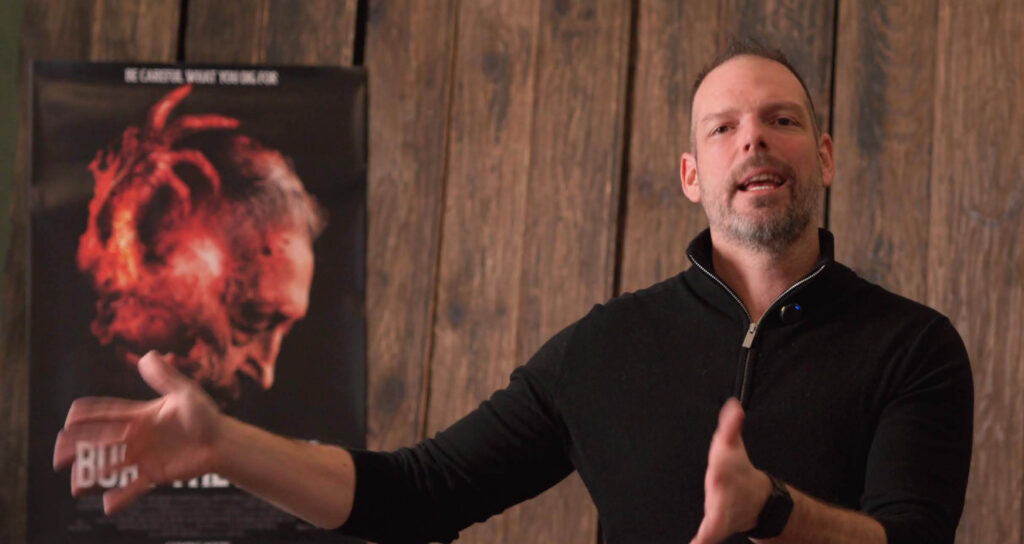
“You make a mistake, you misstep — reframe and continue. We move all the time.” — Adam O’Brien
Quotations have been lightly edited for clarity and length.
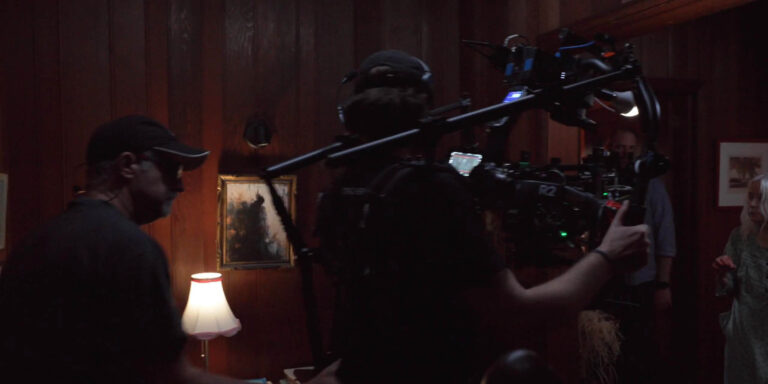
Early in the production of Bury the Devil, the camera operator tripped against a bed. The mistake came during the opening passage through Evelyn’s bedroom, part of a sustained movement expected to survive for approximately fifteen minutes, and in ordinary coverage the take would probably have ended — someone would call cut, the room would reset, and the production would begin again.
Adam O’Brien had established another rule: keep going. “If you make a mistake, you misstep, whatever — reframe,” he recalls. “Continue. We move all the time.” The operator recovered. The actors continued. The take survived.
Later, O’Brien took the portion he liked and used his VFX background to combine it with material from other takes, allowing incompatible camera positions to occupy the same apparent journey The opening sequence ultimately required additional hidden stitching after the operator’s stumble. The rule kept the material alive long enough for editorial and visual effects to rescue what mattered
That rule became a practical instruction on set, but it also describes much of O’Brien’s career. He did not set out to become a producer, financier, distributor, editor, and visual-effects artist in addition to directing; each new discipline arrived because the previous one exposed a problem he needed to solve. He became a producer because he wanted to direct his own work. He learned financing because producing required him to understand companies, taxes, and investment structures. He moved toward distribution because earlier experiences taught him that making the film did not guarantee control over what happened afterward. Editing, meanwhile, taught him how storytelling actually functions inside images: “I learn storytelling through editing,” he says.
His first feature had produced the opposite instinct. Insecurity led him to shoot extensive coverage, uncertain that any one frame contained enough information to carry the scene — more angles seemed safer, and in the edit, abundance became its own burden. Bury the Devil takes that lesson to the other extreme: instead of photographing every possible answer, O’Brien committed the entire film to one apparent camera journey and forced himself to solve each moment inside it.
The One Shot Came First
The story did not produce the form. The form produced the story. The initial challenge came from cinematographer and producer Benoit Beaulieu, a longtime collaborator who proposed making a feature in one continuous shot, and O’Brien’s first response was immediate: “You’re fucking nuts.” He understood what the choice would remove. A conventional film can cut forward two days, move closer to a face, isolate an object, leave one character for another, or provide breathing room between major events; a real-time continuous film has to justify every minute, physically travel between locations, and develop its characters without the ordinary compression of editing.
Once O’Brien accepted the challenge, those restrictions began rewriting the project almost immediately. The earliest version was a home-invasion story involving a young couple, an isolated house, and strangers trying to enter, but O’Brien worried that sustaining exterior threat while remaining inside a single apparent shot would be difficult and familiar, so he inverted the premise instead: the people outside do not want to get into the house. They want the people inside to come out — something dangerous is already there. Writer Brad Hodson eventually suggested that the danger should be possession, that the older woman inside the house was carrying the very thing the outsiders feared, and the screenplay was rebuilt around Evelyn, Julia, the buried statue, and the history that destroyed Evelyn and Randall’s family.
But the form kept applying pressure. O’Brien needed a plot the performers and crew could execute with limited time and money — the principal actors arrived only about two weeks before photography, and the story had to remain memorable while they tracked dialogue, props, marks, camera position, entrances, emotional turns, and physical movement through lengthy sections. His own phrase is blunt: he had to “dumb down” the screenplay. He does not mean removing intention; he means reducing mechanical complexity so the production could concentrate its resources elsewhere.
The final story became a comparatively direct possession narrative. Atmosphere inherited some of what plot complexity surrendered, the camera became both witness and lurking presence, and the structure began calmly and climbed toward violence like a ride gaining speed. “Let’s commit to that,” O’Brien remembers deciding. “It’s a rollercoaster ride, B-movie style.”
The apparent continuous shot was therefore not a flourish applied to an otherwise finished screenplay. The premise, number of characters, mythology, rhythm, and eventual trilogy structure were repeatedly redesigned until the film could survive the method chosen to photograph it. The finished film carries some of that compromise openly: its mythology is larger than the chapter can fully dramatize, Sarah’s history arrives through cassette recordings, the entity’s origin remains incomplete, and the past inhabits voices, symbols, paintings, and fragments because the camera refuses to leave the present for a conventional flashback.
O’Brien knew those limitations were there. He also knew the larger story did not have to fit entirely inside this film. “We found there was so much more to say,” he explains. “So we said, let’s build a prequel and a sequel.” Bury the Devil became the middle movement of that mythology: deliberately heightened, dreamlike, and committed to its real-time B-movie propulsion.
A Year Inside the House
The movie became possible because the house did not belong to a rental company — it belonged to a friend. That relationship gave O’Brien roughly a year of access to the isolated lake property before photography, time the production needed because it did not have enough money to solve every problem through additional shooting days, larger sets, removable walls, or months of full-company rehearsal.
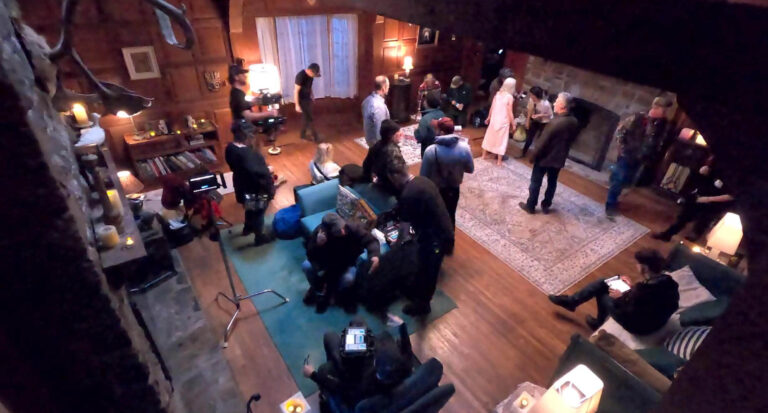
O’Brien did have his own time, so he began walking. With an iPhone and a small stabilizer, he filmed possible routes from room to room, window to window, upstairs to downstairs, and through the surrounding property — the parking area, the garage, the approach from the road. He timed how long it took to move between locations at an ordinary walking pace, photographed the building, created bird’s-eye references, and mapped its rooms as lettered spaces. Those letters entered the screenplay: instead of organizing the script only through conventional scene headings, the production could identify the camera’s progress through Room A, Room B, Room C, and the next physical segment of the journey.
“How do you write a one-shot?” O’Brien asks. “Usually you break with a scene, a moment, the pace. Now you don’t have that.” His solution was mathematical: break the feature into approximately fifteen-minute sections, photograph roughly one section per day, and allow several hours to rehearse, attempt the material multiple times, examine what worked, modify what did not, and continue into the next part of the film. Six sections of fifteen minutes would theoretically produce a ninety-minute feature; the eventual movie would not conform so neatly to the equation, but the equation made the project imaginable.
O’Brien then made Bury the Devil before he cast Bury the Devil. He hired two temporary performers and brought them to the house with producer Philip Kalin-Hajdu. They read the first section, blocked it, photographed it on an iPhone, and moved into the next, and over a weekend they constructed a rough version of the entire film. One of those performers later contributed the voice of young Evelyn on the cassette tapes.
O’Brien assembled the material and watched it, finding the dead spaces, repetitive passages, practical impossibilities, and moments that failed to generate interest. Then they rewrote the screenplay and did it again. Only after those complete practice versions did the production move into final casting. That process was not conventional previsualization; it was closer to a functional prototype, one built to test whether the story could physically exist in the house before asking the full production to execute it.
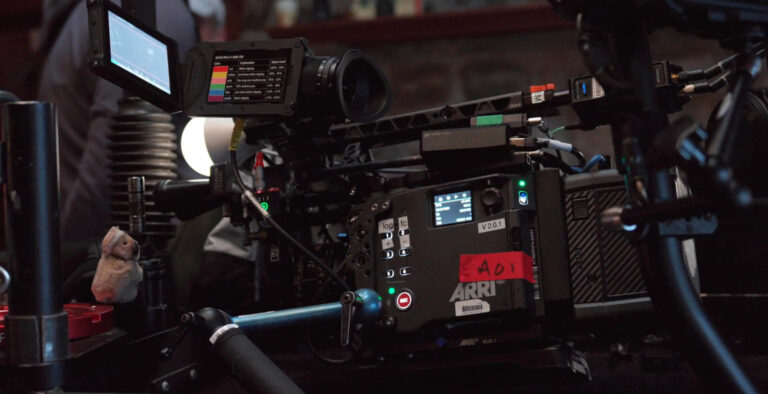
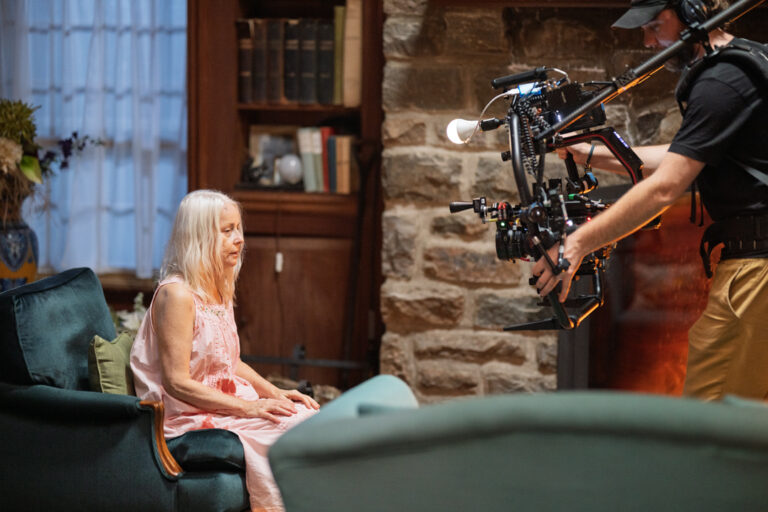
The prototype also exposed a dangerous illusion: a route that worked with one person carrying an iPhone did not necessarily work with an ARRI ALEXA 35, a large operating rig, performers, grips, lighting personnel, and sound moving together. Once the production brought the actual departments through the location, the house began resisting the film they had designed. The older doorways were narrower than expected, the stair dimensions were smaller, walls could not be removed, and the camera that gave the filmmakers the nighttime image they wanted was substantially larger than the device used to design the movements. Shots had to be reconsidered because the equipment simply could not occupy the planned space.
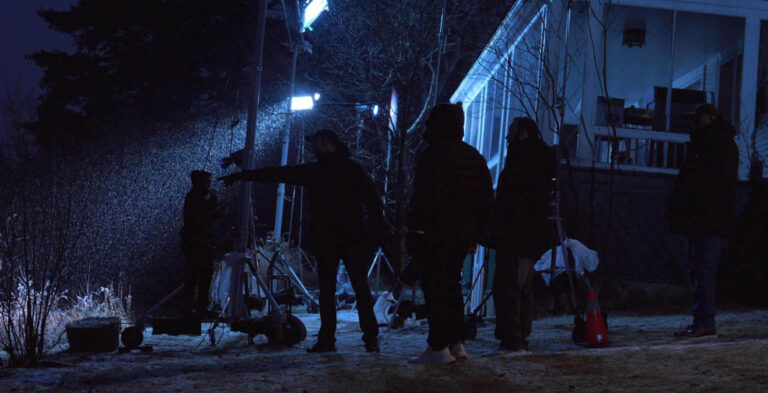
The house also creaked beneath the moving group. O’Brien, the performers, the camera operator, grips, and sound personnel could travel silently enough in theory, but the floorboards disagreed, and the production added carpet — not primarily as decoration, but to absorb the noise created by the filmmaking itself. Lighting presented the opposite problem. Because the camera needed to move freely through the house, the crew could not stop between conventional setups and relight each room, so the property was instead pre-lit with approximately fifty fixtures inside and outside, connected to controls that allowed lights to rise, fade, or disappear as the camera traveled. Once the movement began, the lighting system had to be ready for everywhere the camera might go.
The result is darker than a more conventionally covered film might have been, and O’Brien acknowledges that — there were only so many fixtures the crew could afford, place, control, and keep outside a roaming frame. The film’s shadow did not come from a single department’s aesthetic preference. It came from architecture, sound, camera size, schedule, lighting control, and budget all negotiating the same route.
Backstage Was Everywhere the Camera Wasn't
In the Atlantis Case Study “The Camera Has to Look Away,” the unseen portions of Evelyn’s house were described as a kind of backstage: the camera enters one room, and the abandoned room becomes available. Candles appear in a hallway, symbols emerge on walls, blood and bodies transform the living room, a performer changes costume or physical state — by the time the camera returns, the house has become something else.
O’Brien confirms that the principle was not merely interpretive. Sometimes crew members waited outside the active image, entered after the camera departed, completed a reset, and disappeared before it returned; sometimes the actors performed the work themselves. “They hide, they wait, and they do their thing,” O’Brien says. The film’s apparently continuous world was therefore divided into two simultaneous spaces: the part the audience could see, and the part where the production could still work.
Not every transformation required a hidden cut, and not every hidden cut existed to disguise the boundary between two fifteen-minute sections, either. The planned segment joins gave O’Brien a basic structure, but additional edits emerged because the best overall take did not always contain the best version of every moment — he might prefer Take Two for almost the entire section but favor one reaction from Take Three and another movement from Take Five. His problem was no longer choosing the best take. It was determining whether several best takes could be made to occupy one apparent shot.
That was where O’Brien’s editing and visual-effects background became inseparable from his directing. He adjusted framing, scale, speed, and camera movement gradually before the intended transition, brought two images toward a shared visual point, performed the necessary composite, then slowly returned the frame to its natural position afterward. A two-second stitch might require transformations beginning ten seconds before the cut and continuing several seconds after it — the audience sees one motion, but the image has been bending toward the seam for much longer.
The opening bedroom sequence alone contains multiple hidden cuts. None of those transitions had been designed as the centerpiece of the sequence; they existed because the take containing the movement O’Brien wanted also contained the operator’s stumble. The rule kept the take alive long enough for editorial and visual effects to rescue what mattered.
Toward the end of our conversation, I told O’Brien the phrase I wanted to build this piece around, and asked if he’d let me use it: “The rule of, if you trip, keep going.” “Oh, yeah, go, go, go for it,” he said. It wasn’t the wording he had used to describe the rule — the actual instruction was plainer and blunter, the one quoted at the top of this piece — but he recognized immediately what the phrase described. That is when the set instruction became the title of this piece.
The Camera Was Too Large for the Scene
One of Bury the Devil‘s most conspicuous impossible movements was not part of the original plan. After Randall locks Julia in an upstairs room, the camera lowers to the keyhole and passes through it, leaving Julia behind while continuing into the hallway. The sequence had initially been blocked in the corridor, but during rehearsal the team discovered that the camera rig did not fit. Moving the confrontation into the bedroom improved the scene, allowing the door to become a temporary division between Julia and Randall — but it also trapped the camera with her.
Kalin-Hajdu noticed the keyhole. Could the camera leave through that? O’Brien did not yet know how, but he knew enough to attempt it. The final passage combines three photographed elements: the production filmed the room-side movement toward the lock, filmed Emmanuelle Lussier Martinez separately against green screen so her image could be replaced where necessary, then opened the door and photographed the hallway-side continuation. O’Brien joined the elements and constructed a dimensional keyhole in CG, giving the passage depth and perspective rather than treating it as a flat graphic through which the image simply dissolved. The rig’s inability to leave the bedroom created the problem. The problem produced one of the movie’s defining images.
That does not mean every compromise became invisible, or that every limitation secretly improved the film. The Case Study identified one transition around the fifty-four-minute mark where the camera appears to rotate from inside the house to outside, but the resulting orientation contradicts the journey represented onscreen: the visible spin communicates approximately 270 degrees of rotation, while the exterior geography corresponds to roughly ninety. Repeated viewing could identify the contradiction. It could not explain why the filmmakers accepted it.
O’Brien could. The original route would have followed Julia toward a window, through another section of the house, down a staircase, and out toward the deck — the move had been rehearsed, the departments understood it, the route worked. On the shooting day, the team discovered that the lighting structure occupied the intended path. Removing it would take approximately two hours, and the same structure would then have to be rebuilt because the production still needed it. The planned camera route no longer existed, so O’Brien improvised another.
The approaching boat was added in visual effects. The camera was redirected toward a different window. A curtain was placed inside the house and photographed as the camera entered it, then the same curtain was moved outside and used to begin the continuation; O’Brien matched the speed of both movements and added roughly five frames suggesting passage through the window. The compromise remains visible if the house is mapped closely enough — the hidden join does not fully preserve directional geography. But the compromise is no longer mysterious. It is the record of an entire lighting system standing where the camera was supposed to go, and a production without the hours or money required to move it. Production history does not erase the weakness of the finished transition. It explains the decision that produced it.
The Gore Was Too Expensive to Show
Late in the film, Randall and the surviving men surround Evelyn in the living room and attempt an exorcism. The demon attacks. Julia runs upstairs, and the camera follows her while the massacre continues below through screams, impacts, roaring, and the sound of bodies being destroyed. Julia reaches the upper hallway, collapses against the wall, and covers her ears; her cry absorbs the violence, and the mix falls into ringing and then silence. When she returns downstairs, the living room has become an aftermath.
The Case Study treated that sequence as one of the clearest demonstrations of the apparent continuous shot creating a powerful offscreen — the camera abandons spectacle, gives the violence to sound, and returns only when Julia is ready to confront its result. O’Brien’s explanation begins less romantically. “One-shot and gore is so hard.” He had imagined more explicit violence, including a detailed attack on the priest, and the camera could theoretically whip away, allow practical elements and performers to reset, then return — O’Brien knew how he might construct it. The effects were too expensive. “It’s just a question of money,” he says.
The production needed enough unseen time to prepare Evelyn, place blood, change the room, and transform the performers, and following Julia upstairs supplied that time. Then sound designer Christian Rivest proposed the sequence’s defining choice: instead of continuously adding more sound to the carnage, take it away. The violence begins loudly enough for imagination to construct what the camera has refused to show, and Julia’s emotional collapse then becomes the transition out of it — the audience remains with her while the massacre disappears beneath her distress.
O’Brien still recognizes what some horror viewers lose. A portion of the audience wants to see the priest torn apart, and he wanted to give them at least some of that image, but the budget did not allow it. Leaving the violence also created a stronger connection to Julia, though — the scene became less about cataloguing Evelyn’s attacks and more about what one more traumatic event does to the person the film has followed through the house. The compromise did not turn into secret perfection. It changed jobs: the gore moved offscreen, sound inherited the violence, Emmanuelle inherited its emotional consequence, and the hidden living room became available to the crew.
The Actors Had to Carry the Whole Take
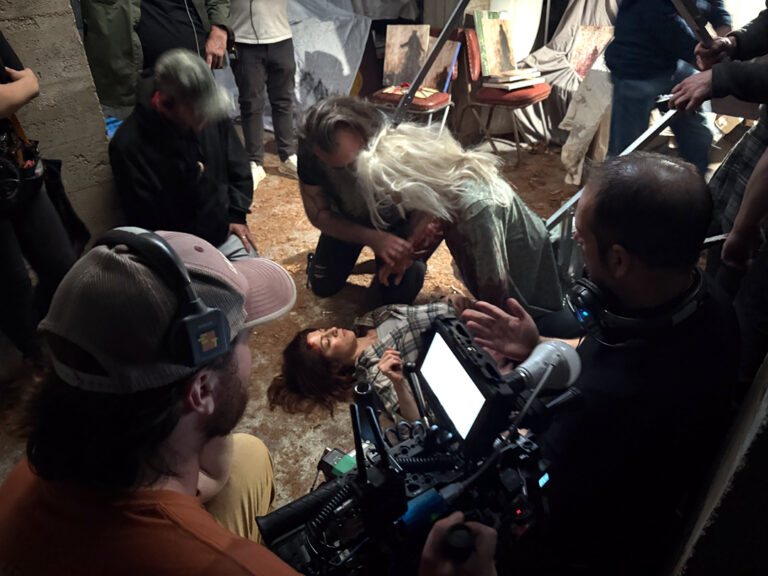
Long-take filmmaking is often described through camera choreography, but the performers are the ones who must make the choreography look like behavior. Lussier Martinez could not simply arrive at Julia’s breakdown for an isolated close-up; she had to travel there through the preceding rooms, dialogue, marks, props, camera adjustments, and escalating fear, and if the production repeated the section, she had to reconstruct the complete chain. O’Brien praises her attention to detail and her willingness to adjust during rehearsal and photography — the team had not spent months repeating an identical stage piece, and many choices were still being refined on the day. She had to remember not only what Julia felt, but where the camera would be, which object she touched, what she carried into the next room, and how each behavioral detail would need to survive another complete attempt.
O’Brien describes her as a “trooper.” He also acknowledges that the performance is sometimes intentionally larger than strict naturalism: Bury the Devil was built as a heightened B-movie ride, and Julia’s fear needed to remain human while existing inside a world of violent possession, demonic limbs, ritual symbols, and an elderly woman throwing grown men across rooms. The size was conscious. The emotional continuity still had to be earned.
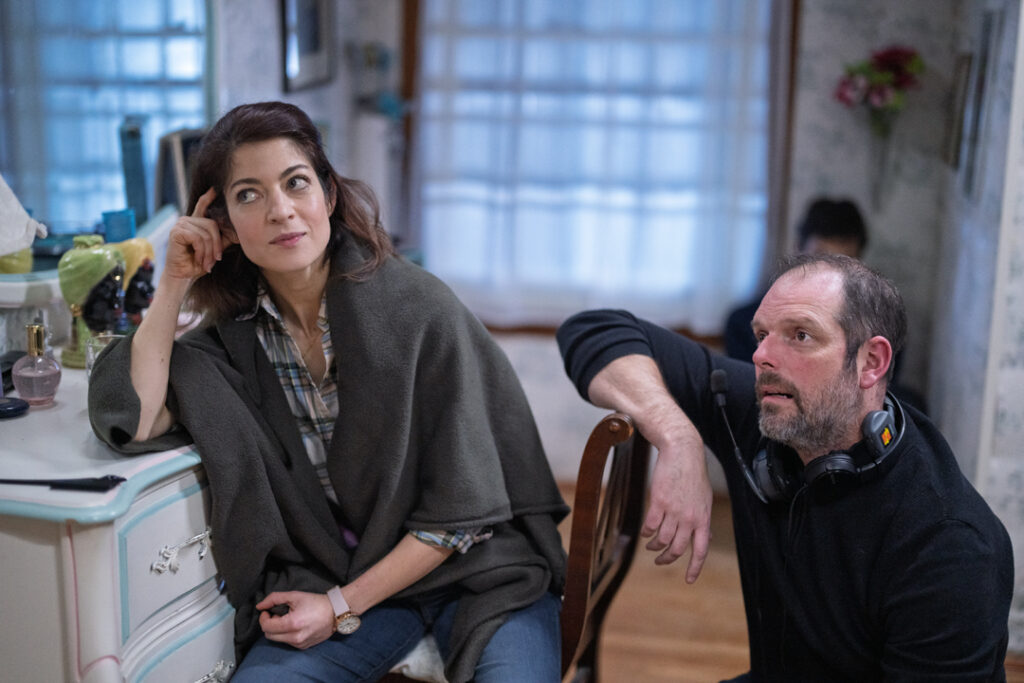
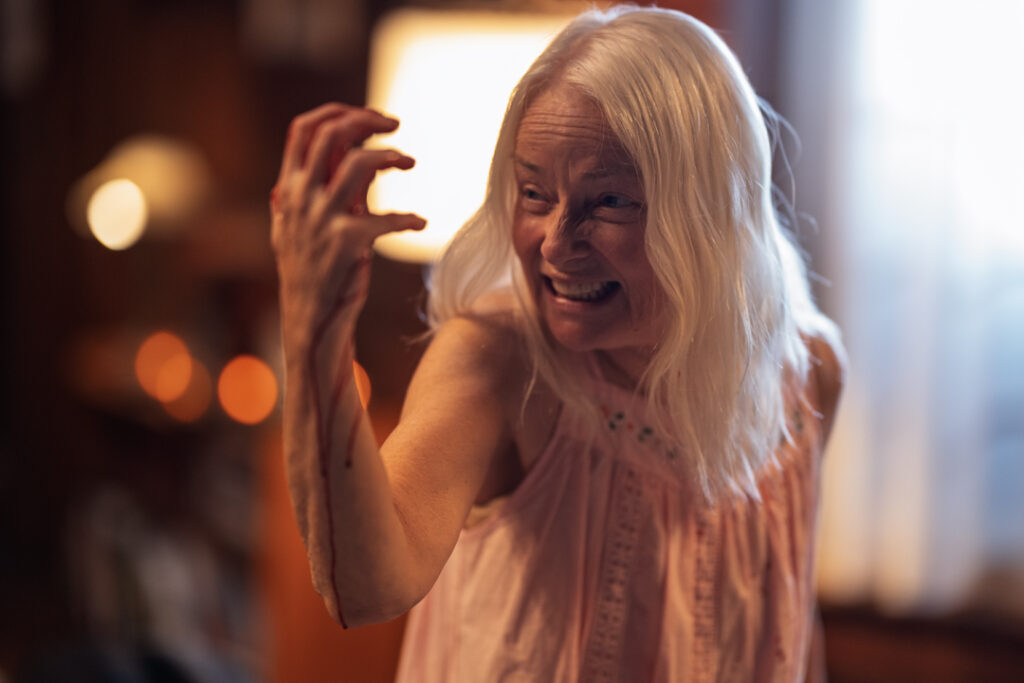
Emmanuelle Lussier Martinez and Dawn Ford faced different versions of the same long-take problem: emotional and physical states had to evolve through sustained choreography rather than being constructed from isolated coverage.
Dawn Ford faced another version of the same problem. Evelyn moves between warmth, confusion, cognitive instability, frailty, predatory strength, guilt, and possession, and Ford often receives no visible edit separating those states — her body has to change while the audience is still watching. O’Brien wanted the instability to support the horror film’s uncertainty without pretending he was making the same kind of clinical character study as The Father; the genre announces that something supernatural will emerge, and the interest, for him, lies in how Ford gets there — and how she descends back into someone apparently fragile afterward. The camera can hide practical effects. It cannot manufacture the entire transformation for her.
The Movie Was Ten Minutes Short
The most disruptive problem arrived after most of the film had already been photographed. Production was scheduled for six overnight shooting days: five consecutive nights, one nominal day off, then a final night to complete the movie. The day off was not a day off. The original plan called for an editor to assemble each section alongside production, providing a second pair of eyes while the crew could still respond. That arrangement didn’t survive the shoot, leaving O’Brien to take over the developing assembly himself. Partway through the shoot, he realized he had not properly watched the developing film, and on the break day, he assembled the material quickly with the script supervisor nearby. The calculation failed: the final movie would be approximately ten minutes shorter than expected. “We need to figure something out.”
The easiest answer would have been to extend existing material without changing its function, but O’Brien did not think the original early sequence was doing enough to deserve the added time. In that version, Julia largely remained outside Evelyn’s bedroom, discussed the necklace, unpacked, used the bathroom, and continued downstairs, while Evelyn’s prayer was present but mostly inaudible. The material occupied time. It did not sufficiently develop the house or Julia’s experience of entering it.
O’Brien wanted her to wander. A stranger staying in an unfamiliar lake house would not immediately behave as though it were home — she would explore the room, listen to the building, inspect what other people had left behind, sit with the silence, and perhaps become bored, and that boredom mattered: the haunted-house rhythm needed quiet before it could accelerate. Kalin-Hajdu rewrote the section rapidly, with writer John Petrizzi assisting, and new pages went immediately to the performers.
Then the entire production had to travel backward. The movie had been photographed chronologically — blood had appeared, costumes had changed, Evelyn’s injuries and Julia’s condition had advanced, and props and set elements had accumulated throughout the house. The crew had been preparing to complete the final puppet sequence. Instead, they were told to restore an early state of the movie: blood had to disappear from Evelyn, Julia’s later wounds had to be removed, wardrobe had to return to Day One, objects had to be replaced, and the house had to remember what it looked like before the production allowed it to change.
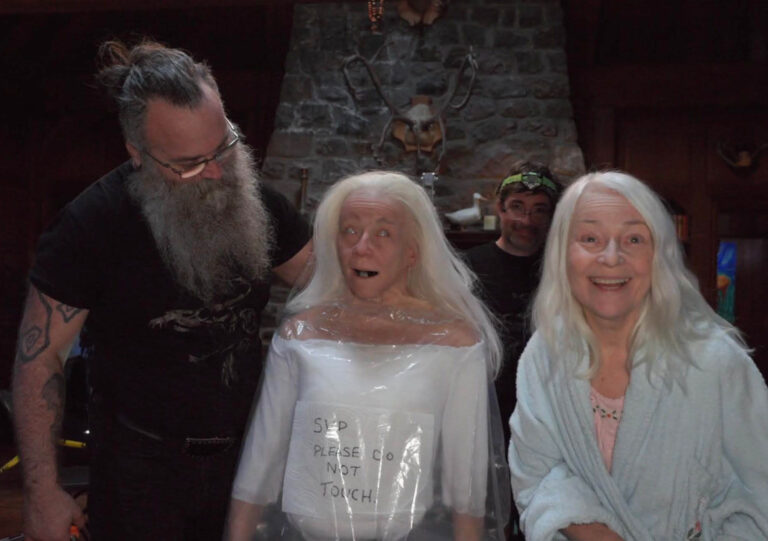
And O’Brien needed a hidden transition that had never been designed. We discussed the hidden transition, and I won’t reveal it here. I’ll just admit that I, as someone who spends much of his waking hours scrutinizing film in depth, did not spot it. It’s a clever stitch, and he snuck it past me.
Once the technical join was possible, the performers had room to explore the new material. Lussier Martinez developed Julia’s repetitive hand washing as a nurse’s behavioral habit, and her inspection of Evelyn’s toiletries emerged inside the revised passage. So did one of the film’s funniest lines: Julia mutters, of Evelyn’s painting, “Color contrast, my ass.” That was improvised.
The scene added because the film was ten minutes short became a mixture of emergency writing, restored continuity, VFX problem-solving, actor invention, haunted-house atmosphere, and character behavior. It is not simply additional runtime. It is the whole production process compressed into one section.
Before Bury the Devil, There Was Sequence
The company that owns the finished film still carries an earlier name: Sequence Film LLC. During development, the movie itself was called Sequence, and O’Brien confirms that the title referred partly to the long-take design — the film as one sequence of events — but also to an earlier version of the story. Before the possession narrative fully emerged, the house contained something closer to a puzzle: characters would need to perform actions in a particular sequence to unlock what was hidden inside. The idea demanded more architectural transformation, more visual information, and more complicated movement between clues. The form rejected it: “You need to go see something, to do something. We need to build a wall now to go to the other side. How the hell am I going to do that with the budget I have?” The concept survived in the company name. The screenplay did not — Sequence became Bury the Devil before the project was publicly announced.
O’Brien remains precise about how he wants the finished film described. Not an exorcism film. Not literally a one-take film. A real-time possession horror movie. He resisted marketing language that promised an uninterrupted photographed take because he understood genre audiences well enough to know that the wrong claim could overwhelm the work itself. “Don’t sell one shot when it’s not a one shot,” he says. “I’m one of those guys.”
The movie is constructed from long takes, hidden edits, composites, performance substitutions, visual effects, and on-set resets. None of that diminishes the formal achievement. It names the achievement accurately: the production did not point a camera at a house for seventy-five minutes and hope a film happened. It built the appearance of continuity from hundreds of decisions about where continuity could bend without breaking.
Controlled Chaos
O’Brien repeatedly returns to Benoit Beaulieu and Philip Kalin-Hajdu when explaining how the film survived. The three have been friends for years, and each possesses strengths the others do not; the relationship provides trust, complementary skills, and shorthand inside a process that can become difficult enough without collaborators learning one another in real time. “Making movies is chaos,” O’Brien says. “Controlled chaos.” He wants to keep that chaos fun — otherwise, he says, there are many easier things he could do with his life.
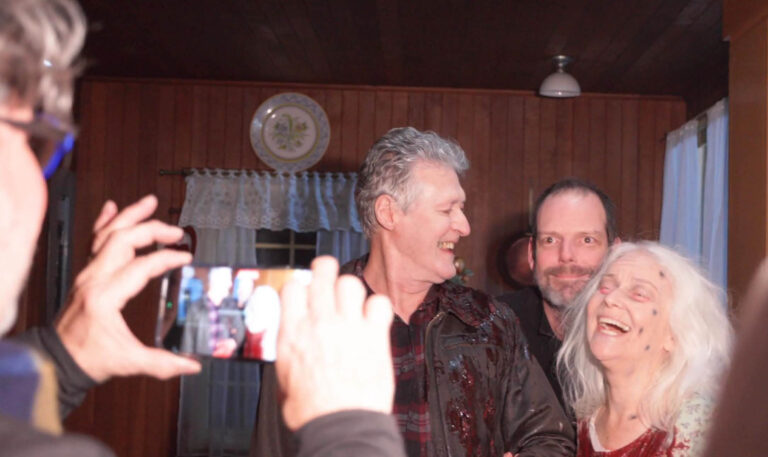
Bury the Devil was not made by discovering the perfect plan and obeying it. It was made by preparing extensively enough to survive the moment the plan stopped working. The one-shot idea arrived before the story, so the story changed. The iPhone fit through the house, but the ARRI ALEXA 35 did not, so the blocking changed. The crew made the floor creak, so carpet entered the production design.
The camera could not escape the bedroom, so it passed through a keyhole. A lighting structure blocked the planned exterior route, so a curtain, a digital boat, two separately photographed moves, and roughly five frames suggesting passage through the window created another. The gore was too expensive, so the camera followed Julia and sound carried the massacre.
The movie was ten minutes short, so the screenplay changed, the house returned to an earlier state, an unplanned seam was built, and the actors found new behavior inside the added time. The best take contained the wrong moments, so editing and visual effects allowed better moments from other takes to enter it. The operator tripped, and everyone kept going.
That last rule can sound like a simple slogan about perseverance. It was not. Continuing only worked because the production had spent a year learning the house, because O’Brien understood editing well enough to recognize what could later be repaired, because his visual-effects experience allowed him to invent transitions no one had planned, and because Beaulieu, Kalin-Hajdu, the actors, sound, lighting, camera, art, makeup, and effects understood that every department’s work might become another department’s solution. Preparation did not prevent chaos. It made adaptation possible.
Bury the Devil looks like a movie whose camera never stops. Behind it is a filmmaker who learned, repeatedly, that moving forward does not mean preserving the original route. Sometimes it means reframing. Sometimes it means rebuilding. Sometimes it means letting another department inherit the moment you can no longer afford to show. And sometimes, when the camera strikes the bed, it means refusing to call cut.
If you trip, keep going.